
Heritage is not preserved by institutions alone. It lives through the people who carry stories, practices, memories, and traditions across generations. This spirit of collective stewardship shaped the three-day Batobalani sa Kabilin Workshop, a landmark heritage initiative that gathered scholars, cultural workers, community leaders, heritage practitioners, and young advocates to strengthen the safeguarding of the intangible cultural heritage of the Santo Niño de Cebu devotion.
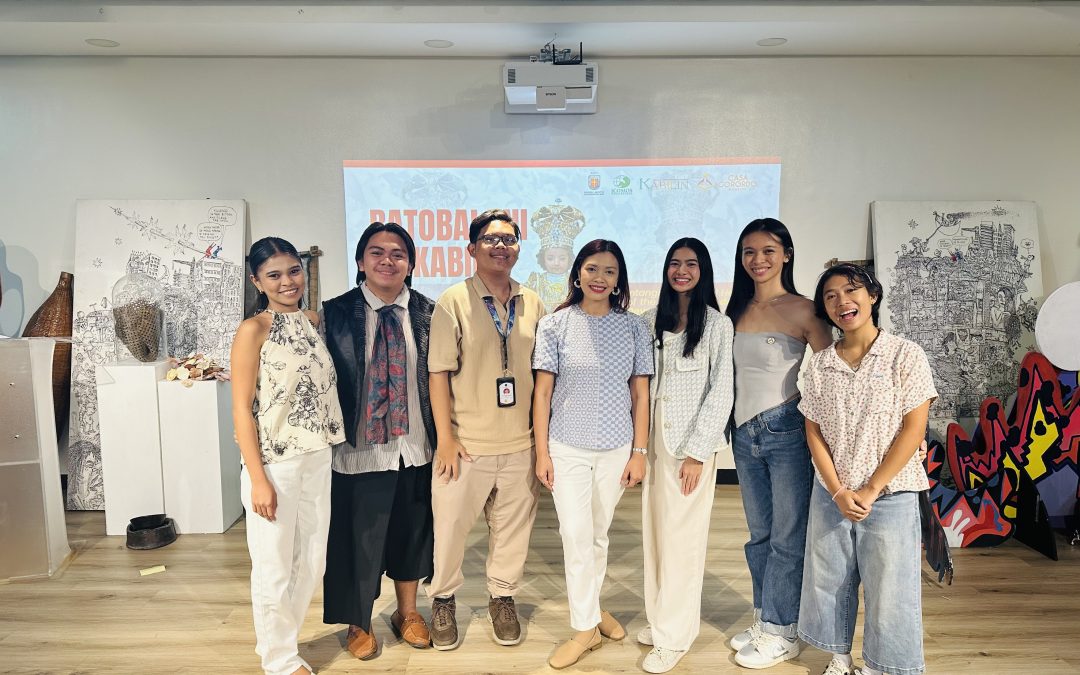
Among those who contributed to this meaningful gathering were volunteer students from the University of the Philippines Cebu College of Communication, Art, and Design (CCAD) Communication Program, who served as part of the Kabilin Youth Partners. Responding to an open call for volunteers, the students participated not as part of any academic course requirement but as young communicators eager to engage with heritage work and contribute to the documentation and organization of a significant cultural initiative.
The student volunteers, composed of Ma. Athena E. Quidlat, Hazel Mae Bergantin, Charice Mae Basilan, Uriel Cabuguas, Samantha Talla, and Mike Navales, supported various aspects of the workshop, including documentation, participant assistance, and logistical coordination. Their involvement reflects the growing role of youth in heritage safeguarding, where communication, storytelling, and community engagement become essential tools in sustaining living traditions.
Convened by UP Cebu Fine Arts – Studio Arts Coordinator and ICOMOS Philippines member Dr. Laya Boquiren Gonzales, the Batobalani sa Kabilin Workshop is part of the Intangible Cultural Heritage of the Santo Niño de Cebu Devotion Project (Project Batobalani), a five-year action research initiative focused on understanding, documenting, and strengthening the cultural practices and communities surrounding one of Cebu’s most significant expressions of living heritage.
The workshop was implemented through the Kabilin Partnership between the Ramon Aboitiz Foundation Inc. (RAFI) and the International Council on Monuments and Sites (ICOMOS) Philippines. Drawing from the meaning of batobalani as a force that brings people together, the initiative emphasized that safeguarding heritage requires collaboration among communities, cultural institutions, researchers, government agencies, and heritage practitioners.
Across three days, participants explored approaches to safeguarding that went beyond documentation. Discussions highlighted the importance of strengthening relationships, knowledge systems, institutions, and communities that sustain the Santo Niño devotion. Through research exchange, safeguarding planning, education, interpretation, and community engagement, the workshop created a platform for collective reflection on how living heritage can continue to thrive for future generations.
The workshop brought together a diverse network of stakeholders representing the broader cultural ecosystem of the Santo Niño de Cebu devotion. Participants included representatives from Basilica community organizations, partner barangays, local government units, museums and heritage interpretation centers, academic institutions, image bearers and caretakers of devotional images, Sinulog culture bearers, craft artisans, tourism officers, cultural workers, and devotees.
The workshop also featured a distinguished lineup of heritage experts and cultural practitioners who shared their knowledge and perspectives on safeguarding living heritage. Speakers and panel discussants included UNESCO Philippine National Commission Secretary General Dr. Ivan Anthony Henares; Dr. Laya Boquiren Gonzales; National Committee on Monuments and Sites Member, National Commission for Culture and the Arts and University of the Philippines Los Baños faculty member Bernie Arellano; Cavite historian and ICOMOS member Phillip Medina; cultural worker and anthropologist Nestor Horfilla; National Commission for Culture and the Arts Program Management Division Chief Renee Talavera; CHAC Commissioner and conservation architect Ar. Melva Java; historian and University of Navarra PhD graduate, Dr. Svetlana Camacho; and Cebu Normal University Assistant Professor Ian Dale Rios.
Through their participation, the UP Cebu CCAD student volunteers became part of a larger conversation on heritage, communication, and community. Their experience demonstrates how young communicators can contribute to cultural preservation not only by telling stories but also by actively participating in the processes that keep those stories alive.
Project Batobalani acknowledges the support and partnership of ICOMOS Philippines, Ramon Aboitiz Foundation Inc. (RAFI), and Casa Gorordo Museum, together with the venue partners and hosts Cebu City Museum, Basilica Minore del Santo Niño de Cebu, and The Kabilin Center. The project also recognizes the contributions of the UNESCO Philippine National Commission and the National Commission for Culture and the Arts (NCCA) in enriching conversations on heritage safeguarding in the Philippines and beyond.
As the workshop demonstrated, safeguarding heritage is ultimately a shared responsibility. Through partnerships between institutions, communities, and the next generation of cultural advocates, traditions such as the Santo Niño de Cebu devotion continue to find new ways to endure, evolve, and inspire.
Photo contributed by the CCAD Volunteers