
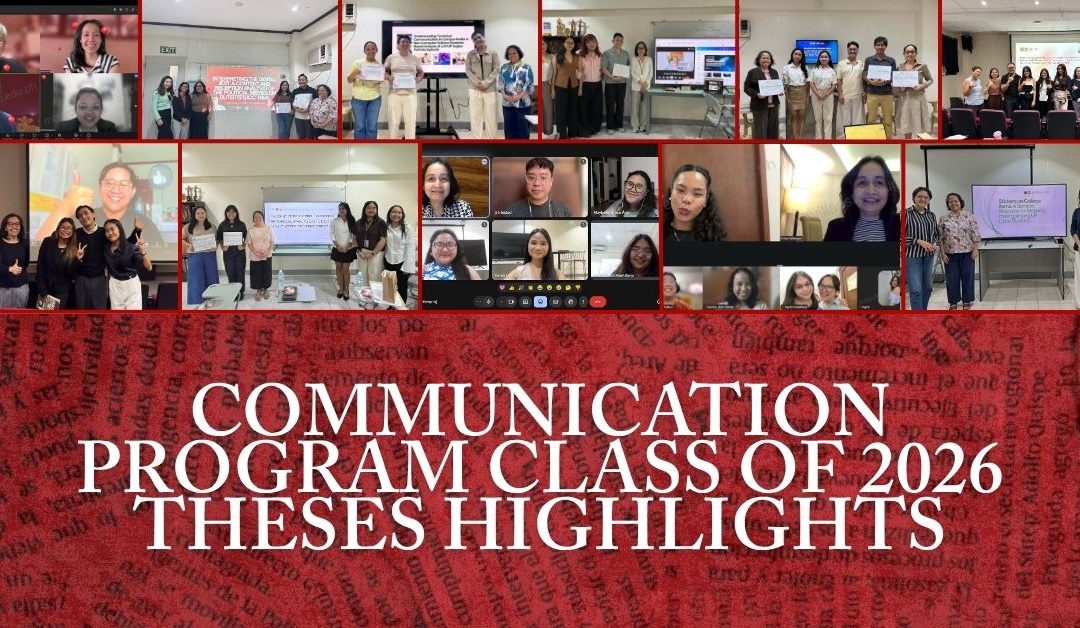
From media framing and digital culture to climate communication and community-centered research, the graduating BA Communication Class of 2026, also known as Batch Sidlak, presents a compelling body of scholarship that demonstrates the breadth and relevance of communication research in contemporary society. Through studies grounded in critical inquiry, cultural analysis, development communication, and digital media studies, the graduates examine how meanings are produced, negotiated, and contested across institutions, communities, and everyday life.
Collectively, these undergraduate theses reflect the program’s commitment to addressing pressing social issues while advancing communication theory and practice. Their research contributes not only to academic discourse but also to ongoing conversations about media responsibility, climate resilience, tourism development, digital participation, and political engagement in the Philippines.
Reading Between the Frames: A Comparative Analysis of Rappler and Philstar’s Online Reportage on the Adolescent Pregnancy Prevention Bill (Senate Bill No. 1979)
Researchers: Kyla Niña Espinosa, Elizabeth Salarde, Meg Nathalie Valeros
In a media environment where public understanding of policy issues is often shaped by journalistic narratives, Kyla Niña Espinosa, Elizabeth Salarde, and Meg Nathalie Valeros investigated how two major Philippine news organizations framed one of the country’s most debated reproductive health measures. Their study examined 30 online news articles published by Rappler and Philstar between 2023 and 2025 concerning the Adolescent Pregnancy Prevention Bill, exploring how media institutions construct meaning around adolescent reproductive health and public policy.
Drawing from framing theory, digital rhetoric, and media hegemony, the researchers found that both outlets relied heavily on conflict and responsibility frames while advancing distinct ideological orientations. Rappler foregrounded institutional accountability and policy contestation, while Philstar situated discussions within moral and religious frameworks. Despite these differences, both news organizations largely privileged elite voices and paid limited attention to economic and class-related dimensions of adolescent pregnancy.
The study highlights the influential role of journalism in shaping public discourse around gendered policy issues. By demonstrating how media narratives simultaneously negotiate and reproduce dominant social values, the research contributes to broader conversations about media power, democratic deliberation, and reproductive health communication in the Philippines.
The City is Sea-nking: Determining the Explicit-Tacit Knowledge Divide Among Fisherfolk in Mandaue City Coastal Communities on Sea Level Rise through Narrative Storytelling
This undergraduate study was awarded Second Place in the Ganti sa Hamiling Paniksik sa Komunikasyon
Researchers: Cris Fernan Bayaga, Alyanna Nicole Lauzon, Lynda Katherine Mecaros
As climate change increasingly affects vulnerable coastal communities, Cris Fernan Bayaga, Alyanna Nicole Lauzon, and Lynda Katherine Mecaros turned their attention to the experiences and knowledge systems of fisherfolk in Mandaue City. Through narrative storytelling, the researchers explored how coastal residents understand and respond to the realities of sea level rise, emphasizing the value of local knowledge in environmental communication and policymaking.
Grounded in Participatory Narrative Inquiry and Knowledge Creation Theory, the study revealed that fisherfolk interpret sea level rise through direct observations and lived experiences rather than scientific terminology alone. Changes in tides, fishing conditions, and daily routines provided important indicators through which participants made sense of environmental transformations affecting their communities.
The findings underscore the importance of participatory approaches to climate communication that place community voices at the center of adaptation planning. By recognizing fisherfolk as active knowledge holders rather than passive recipients of information, the research advocates for more inclusive climate governance that bridges scientific expertise and local realities.
Shared Sea, Shared Risk: A “SEA”mbolic Interactionism Analysis on the Marine-Based Disaster Risk Construct of the Badjaos in Sitio NABA, Mambaling, Cebu
This undergraduate study was awarded Best Thesis in the Ganti sa Hamiling Paniksik sa Komunikasyon
Researchers: Jade Himalaloan, Erna Josette Bonsukan, Adrian Campugan
Jade Himalaloan, Erna Josette Bonsukan, and Adrian Campugan explored how the Badjao community of Sitio NABA in Mambaling, Cebu City constructs and communicates understandings of disaster risk through its unique relationship with the sea. At a time when disaster risk reduction frameworks often prioritize technical expertise, the study foregrounded Indigenous knowledge systems and culturally rooted forms of communication.
Using symbolic interactionism and sociocultural communication perspectives, alongside Indigenous Filipino research methods such as pagdalaw-dalaw and pakikipagkuwentuhan, the researchers found that disaster risk is understood not merely as a technical phenomenon but as a social, symbolic, and relational experience. Environmental cues, including sea color, tides, waves, and depth, served as meaningful warning systems interpreted through collective knowledge and everyday interactions.
The study demonstrates how Indigenous communities develop sophisticated communication systems grounded in local experience, spirituality, and intergenerational storytelling. Its findings call for disaster communication frameworks that recognize Indigenous perspectives and support more culturally responsive approaches to risk reduction and community resilience.
Tracing Transformations: An Actor-Network Analysis of the Touristification Process in Basdaku, Moalboal, Cebu
Researchers: Hannah Gresha Abayon, Andre John Tagra, Alyssa Sofia Agdon
Tourism has transformed many coastal destinations across the Philippines, but what processes enable these changes to occur? Seeking to answer this question, Hannah Gresha Abayon, Andre John Tagra, and Alyssa Sofia Agdon investigated the touristification of Basdaku White Beach in Moalboal, Cebu through the lens of Actor-Network Theory.
The study examined the relationships among a diverse network of actors, including local residents, tourists, tourism workers, government agencies, environmental policies, infrastructure, and natural resources. Rather than viewing tourism development as a straightforward outcome of economic planning, the researchers demonstrated that touristification emerges through ongoing processes of negotiation, adaptation, resistance, and cooperation among interconnected human and non-human actors.
Their findings reveal that communication functions as the central mechanism through which tourism spaces are continuously created and recreated. The research offers important insights for policymakers and tourism stakeholders by emphasizing the need for participatory and sustainable tourism governance that balances economic development with community well-being and environmental stewardship.
Adding It To My TBR: A Digital Rhetorical Analysis of BookTok Influencers’ Content Creation
Researchers: Eulla Cinco, Nathalie Senaca, Crystal Vilvestre
Social media platforms continue to reshape how audiences discover books and engage with reading communities. Recognizing the growing influence of BookTok, Eulla Cinco, Nathalie Senaca, and Crystal Vilvestre examined how content creators use digital rhetoric to cultivate audiences, influence reading habits, and sustain engagement within TikTok’s algorithm-driven ecosystem.
Drawing from Digital Rhetoric Theory and Self-Presentation Theory, the study analyzed how influencers combine visual elements, sound, storytelling techniques, editing styles, and platform affordances to construct persuasive and relatable content. The researchers found that successful BookTok creators strategically balance authenticity, entertainment, and credibility to foster meaningful connections with their audiences.
Beyond understanding online book culture, the study contributes to emerging scholarship on influencer communication and platform-based persuasion. It highlights how digital creators actively shape cultural consumption while navigating the opportunities and constraints of contemporary social media environments.
Interpreting the Digital Jest: A Content and Reception Analysis of the Political Memes of Duterte’s ICC Trial
Researchers: Femme Largo, Linda Bacunador, Tasha Anton
Political memes have become a prominent feature of online discourse, serving as spaces where humor, criticism, and political commentary intersect. In their study, Femme Largo, Linda Bacunador, and Tasha Anton explored how political memes surrounding former President Rodrigo Duterte’s International Criminal Court trial were constructed and interpreted by university students in Cebu City.
Using Hall’s Encoding-Decoding Theory and Walton’s Propaganda Theory, the researchers conducted both content analysis and focus group discussions to examine the rhetorical strategies embedded within these memes and the meanings audiences derived from them. Their findings revealed that humor, satire, parody, and irony function not only as entertainment but also as vehicles for political messaging, shaping public engagement with issues of justice, governance, and accountability.
The study demonstrates the increasingly important role of digital culture in contemporary political communication. By examining both message production and audience interpretation, the research offers valuable insights into how citizens navigate political information in highly mediated and participatory online environments.
Reading the Spiral: Horror Forms, Meaning-Making, and Ideology Disruption in Junji Ito’s Uzumaki
Researcher: Michelle Ellaine Agramon
Popular culture often serves as a lens through which deeper social anxieties and cultural tensions can be examined. In her undergraduate thesis, Michelle Ellaine Agramon explored how horror is constructed and communicated in Uzumaki, the acclaimed manga by Japanese horror artist Junji Ito. Through a close examination of the work’s visual and narrative structures, the study investigated how horror functions as a communicative form capable of disrupting dominant assumptions about everyday life.
Guided by the frameworks of Andrew Tudor, Stuart Hall, and Roland Barthes, the research employed qualitative content analysis and semiotic textual analysis across the manga’s twenty chapters. The study identified four recurring thematic formations: the unraveling body, the unstable mind, the hostile world, and the limits of human control. These themes collectively demonstrate how the manga transforms ordinary experiences into sources of dread through the recurring spiral motif.
Beyond literary and visual analysis, the research offers insights into how horror narratives communicate broader concerns about uncertainty, helplessness, and instability. By connecting the text’s themes to contemporary experiences of crisis and disruption, the study contributes to scholarship on visual culture, popular media, and the communicative power of horror as a cultural genre.
Understanding Technical Communication in Campus Radio: A Non-Computer Science Students-Based Analysis of a DYUP Sugbo TekToks Episode
Researcher: Jarrod Owen T. Ygot
As scientific and technological developments become increasingly relevant to everyday life, effective communication of complex information has become a pressing challenge. Jarrod Owen T. Ygot examined this issue through a study of TekToks, a Computer Science-led radio program aired on DYUP Sugbo. Focusing on an episode featuring Project MANGGA, an artificial intelligence-powered agricultural innovation, the research explored how technical concepts are communicated and understood by audiences without formal training in Computer Science.
Grounded in Heinz von Foerster’s Second-Order Cybernetics, the study investigated how messages are encoded by experts and subsequently interpreted by listeners. Through textual analysis, interviews with non-Computer Science students, and expert validation, the research found that conversational language, code-switching, humor, analogies, and relatable examples helped make complex topics more accessible to audiences.
At the same time, the findings revealed that accessibility does not always guarantee technical accuracy. While participants generally understood the broader goals and applications of Project MANGGA, more advanced concepts such as machine learning and neural networks were often interpreted incompletely. The study underscores the importance of audience-centered science communication and highlights the ongoing challenge of balancing clarity, engagement, and precision in public discussions of technology.
Reimagining Safety: An Interpretive Phenomenological Analysis of Safe Space for Women with Disabilities in Cebu City, Philippines
Researchers: Ingrid Esquilla, Rozan Chaya Marquez, Hannson Namoc
Safety is often discussed in terms of policies, infrastructure, and institutional protections. However, Ingrid Esquilla, Rozan Chaya Marquez, and Hannson Namoc sought to understand safety from the perspectives of women with disabilities themselves. Their study explored how women with disabilities in Cebu City experience, construct, and negotiate safety within their everyday lives.
Using Interpretative Phenomenological Analysis and principles from Sikolohiyang Pilipino, the researchers found that safety is not merely a physical condition but a deeply relational and communicative experience. Participants relied heavily on trusted social networks, personal relationships, and community connections to navigate risks, access opportunities, and participate in public life. While formal accessibility measures and disability-related policies existed, many participants viewed them as insufficient in addressing the realities they encountered daily.
The study contributes to disability studies and communication research by emphasizing the importance of lived experience in understanding inclusion and safety. It calls for more care-centered, disability-inclusive approaches to policymaking and advocacy while highlighting the need to recognize women with disabilities as active knowledge producers whose voices should inform decisions affecting their communities.
Analyzing the Text, Paratext, and Context of Queerbaiting in ABS-CBN’s TikTok and YouTube Promotional Videos in the Darlentina Ship from Mars Ravelo’s Darna (2022)
Researchers: Maria Shaila Montillano, Angelie Grace Oftana, Karen Lei Torrevillas
Questions surrounding representation, visibility, and media commodification continue to shape contemporary discussions of queer media. In their undergraduate thesis, Maria Shaila Montillano, Angelie Grace Oftana, and Karen Lei Torrevillas examined the phenomenon of queerbaiting through the highly popular “Darlentina” pairing from ABS-CBN’s adaptation of Mars Ravelo’s Darna (2022). Their study investigated how promotional content encouraged queer interpretations despite the absence of an explicitly confirmed romantic relationship within the narrative.
Drawing on Craig’s Semiotic Tradition, Chiluwa’s Deceptive Communication Semiotics, and Ng’s text-paratext-queer context framework, the researchers analyzed promotional videos published on TikTok and YouTube alongside audience responses. The study identified recurring strategies such as romantic framing, intimate interactions, suggestive captions, and compilation editing that invited audiences to read the relationship as potentially romantic. These interpretations were further reinforced through fan discussions, shipping practices, and audience engagement across social media platforms.
The findings reveal how queerbaiting can emerge through the interaction between media producers and audiences, creating visibility and engagement while ultimately maintaining dominant heteronormative structures. By examining one of the most prominent examples of queer fan discourse in contemporary Philippine popular culture, the research contributes to growing conversations on representation, fandom, media industries, and queer communication studies.
Stickers on College Items: A Semiotic Resource for Meaning-Making among UP Cebu Students
This undergraduate study was awarded Third Place in the Ganti sa Hamiling Paniksik sa Komunikasyon
Researchers: Gabrielle Aña G. Asprer, Gwyneth Anne S. Tinga
Meaning-making is often found in the smallest and most ordinary aspects of daily life. In their study, Gabrielle Aña G. Asprer and Gwyneth Anne S. Tinga explored how stickers displayed on personal belongings such as laptops and water flasks function as communicative resources among UP Cebu students. What may initially appear as simple decoration emerged as a rich site for identity expression, affiliation, and social interaction.
Using a social semiotic framework, the researchers combined visual documentation, ethnographic observation, and semi-structured interviews to examine the discourses reflected in stickers across both personal items and campus spaces. Their findings revealed that students frequently used stickers to communicate cultural interests, organizational affiliations, political positions, environmental concerns, and aspects of personal identity. The study also documented how campus spaces themselves serve as environments where sticker practices are learned, shared, and reproduced.
The research highlights the role of everyday objects in communication and demonstrates how youth culture and campus life shape symbolic expression. By treating stickers as meaningful semiotic resources rather than mere decorative elements, the study contributes to broader understandings of visual communication, identity construction, and the social life of material culture within university settings.
Expanding the Horizons of Communication Research
The undergraduate theses of Batch Sidlak collectively demonstrate the versatility of communication as a field of inquiry. Across topics as varied as horror manga, campus radio, disability experiences, queer representation, and sticker culture, these studies reveal how communication shapes the production of meaning, the negotiation of identity, and the organization of social life.
These studies showcase a graduating class committed to critical inquiry, social relevance, and intellectual rigor. By engaging with emerging cultural phenomena, amplifying marginalized perspectives, and examining everyday communicative practices, the batch contribute valuable insights to communication scholarship while addressing issues that resonate beyond the university.
As they move forward into professional and academic pursuits, the Batch Sidlak leaves behind a body of work that reflects the program’s enduring commitment to research that is critical, reflective, and responsive to the changing realities of contemporary society.
—
This feature is part of the Pagbudyong 2026 commemoration series, celebrating the graduating Class of 2026 of the College of Communication, Art, and Design. Through these stories, we highlight the thesis and capstone projects of the graduating students in Communication, Product Design, and Studio Arts—works that embody the creativity, critical inquiry, and commitment to meaningful practice that have shaped their journeys at UP Cebu and will continue to inspire beyond the University.