
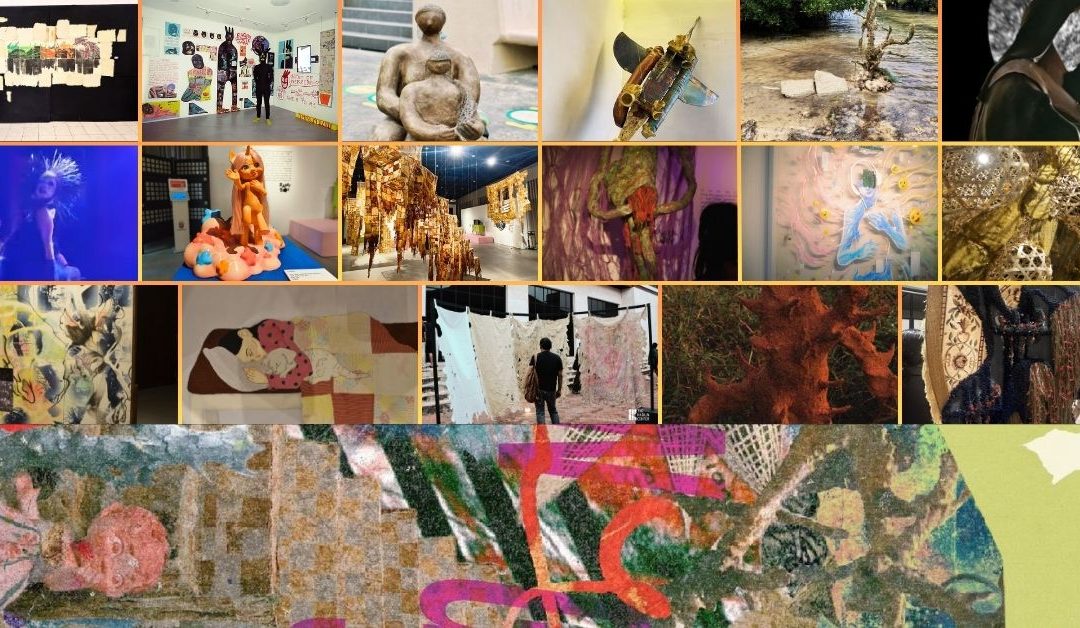
“Salingsing refers to a young shoot emerging from an existing trunk or branch. It is a quiet yet persistent sign of renewal. More than a botanical metaphor, it offers a lens for understanding artistic practice as a process of continual becoming: rooted in inherited histories while reaching toward unforeseen futures.”
The graduating Bachelor of Fine Arts in Studio Arts students of the University of the Philippines Cebu have come together under the collective name Salingsing, presenting a diverse works of seventeen solo thesis exhibitions that reflect the breadth, depth, and evolving directions of contemporary artistic practice.
Spread across galleries, cultural spaces, and alternative exhibition sites in Cebu and beyond, Salingsing serves as both a culmination of years of artistic inquiry and a public presentation of the personal, social, and material concerns that have shaped each artist’s studio practice. While each exhibition stands independently, together they form a collective portrait of a generation of artists engaging with memory, identity, community, ecology, labor, grief, care, and transformation.
The exhibitions reveal how Studio Arts students continue to push the boundaries of medium and form. Handmade paper, printmaking, sculpture, installation, performance, augmented reality, textile practices, weaving, and site-responsive interventions emerge as vehicles through which personal narratives intersect with broader social realities.
JM Valenciano: Gin-Halinan
Gin-Halinan takes its title from the Hiligaynon word halin, which means both “to come from” and “to leave.” Rooted in the sugarcane landscapes of Negros, the exhibition examines the intertwined histories of land, labor, migration, and memory. Through handmade paper produced from sugarcane leaves and layered printmaking processes, Valenciano transforms agricultural byproducts into surfaces that carry traces of place and lived experience. The works evoke fragments of fields, inherited stories, and the enduring presence of communities shaped by plantation life.
At the heart of the exhibition is a reflection on what remains after departure. Valenciano approaches paper not simply as a medium but as a repository of memory, capable of preserving the marks of labor, weather, and time. By bringing together personal recollections and collective histories, Gin-Halinan asks viewers to consider their relationship with land and ancestry, and how landscapes continue to shape identities long after people have moved away.
Read the full catalogue of the exhibition here: https://drive.google.com/file/d/1J7F7ucejJgJ3pqgxrrbsa449FzvgC-Yf/view?usp=drivesdk
Dominic Matthew Ricardo (Kompoztika): KUNGPUSILONTIKAAA
This thesis exhibition was awarded Second Place in the Ganti sa Hamiling Paniksik sa Arte Biswal
In KungPusilonTikaaa, Dominic Matthew Ricardo, known in the local art scene as Kompoztika, confronts a traumatic experience that occurred during the height of the Philippine Drug War. The exhibition draws from a home raid that left a lasting impression on the artist, particularly a chilling question posed by one of the armed men: “Kung pusilon tika, maunsa man ka?” Through paintings informed by poetry, personal memory, and neo-expressionist aesthetics, Ricardo transforms fear and vulnerability into visual narratives.
Central to the exhibition is the figure of JOD, a recurring character that embodies the violence, authority, and god-like power exercised by oppressive systems. Yet, the exhibition is not solely about trauma. It is also about reclaiming agency through storytelling and artistic creation. By turning painful memories into images and symbols, Ricardo shifts the balance of power, demonstrating how art can become a space for reflection, resistance, and personal healing.
“Some works approach difficult experiences through satire and absurdity, while others are more intimate and reflective. Rather than presenting a complete narrative, the paperworks capture moments of uncertainty, vulnerability, confrontation, and imagination, revealing the earliest stages of the artist’s attempt to understand and reframe a traumatic experience involving state violence.”, as expressed by Kompoztika.
Read the full catalogue of the exhibition here: https://drive.google.com/file/d/1jzQK-bLQaGp1XlsqXse3Q_ugO00t5sme/view?usp=drivesdk
Annalyn Labra: Amuma
Named after the Bisaya word for nurturing and caregiving, Amuma pays tribute to the women whose labor sustains households, communities, and generations. Through sculptural works and material explorations, Labra highlights everyday acts of care that often go unnoticed despite their profound impact on people’s lives. The exhibition draws inspiration from the women in the artist’s family, community, and personal experiences.
Rather than presenting care as a singular gesture, Labra frames it as an ongoing and collective process that shapes identities and relationships. The exhibition invites viewers to recognize caregiving as a form of labor, resilience, and strength. By honoring women who have served as pillars of support, Amuma becomes both a celebration and an acknowledgment of the emotional and physical work that underpins communal life.
Read the full catalogue of the exhibition here: https://drive.google.com/file/d/1Po0MjhQEIiGagbvXrkt0f9LyKYafQ7iU/view?usp=drivesdk
Candy Regine Casinillo: ARIYA
Derived from a Filipino fishing term referring to the lowering of nets and fishing gear into the sea, ARIYA explores the rhythms, traditions, and realities of coastal life. Casinillo draws from the experiences of fishing communities, reflecting on the labor, patience, and trust required to live alongside the sea. Through carefully considered materials, textures, and forms, the exhibition evokes both the physical and emotional landscapes of maritime culture.
The works emphasize how objects can carry memories and cultural meanings beyond their immediate function. Fishing tools, coastal environments, and everyday practices become entry points into conversations about heritage, livelihood, and belonging. Through ARIYA, Casinillo presents art as a vessel capable of preserving stories that might otherwise be overlooked, reminding audiences of the deep connections between people, place, and tradition.
Read the full catalogue of the exhibition here: https://drive.google.com/file/d/1NQ34eacqVV8wmOYyJPIhHZjGsOwH2Rl9/view?usp=sharing
April Maureen Burcila: LÍM-AW
This thesis exhibition was awarded Third Place in the Ganti sa Hamiling Paniksik sa Arte Biswal
Situated along the shoreline of San Remigio, Cebu, LÍM-AW transforms the coast into a living exhibition space where the artwork remains in constant dialogue with the environment. Burcila’s site-specific installation uses cement forms placed directly on the beach, allowing natural forces such as tides, waves, and weather conditions to continuously alter the work over time.
By embracing change rather than resisting it, the exhibition reflects on impermanence and ecological interconnectedness. The shifting conditions of the shoreline become collaborators in the creative process, blurring the boundaries between artistic intention and natural transformation. Through this engagement with the sea, LÍM-AW encourages viewers to reflect on humanity’s relationship with nature and the fleeting qualities of both memory and material existence.
“At its core, LÍM-AW is about living with something that never stays the same. In the artistʼs hometown, change is not dramatic—it is slow, ordinary, and constant. The exhibition holds this reality: that what is placed by the shore is never finished, because the sea always continues it.”, explained by Burcila.
Read the full catalogue of the exhibition here: https://drive.google.com/file/d/1kf1OHIz8rJffLyUyMnF_3C3vJjRH4qPF/view?usp=drivesdk
Josephine Marie Gentallan: Black Box
Through video art and digital media, Black Box examines the growing influence of surveillance capitalism and algorithmic systems on contemporary life. Gentallan investigates how technology increasingly predicts, shapes, and influences human behavior, often without users fully realizing the extent of its reach. The exhibition draws from concepts of instrumentarianism and automation to question the invisible structures governing everyday experiences.
The title references systems that operate beyond public understanding, functioning as opaque mechanisms that collect information and guide behavior. By exposing these processes, Black Box invites viewers to consider the implications of living within systems designed to monitor and anticipate human actions. The exhibition ultimately asks whether true freedom remains possible when decisions, desires, and interactions are increasingly mediated by technology.
Read the full catalogue of the exhibition here: https://drive.google.com/file/d/1xtyKG5MqqlR1FclQUtUTZDs59JJIjnNK/view?usp=drivesdk
Ehd Aiken Calaguas: afterhOURS
afterhOURS situates performance within the spaces and temporalities of nightlife, exploring drag as both artistic expression and critical inquiry. Through performance-based practice, Ehd Aiken Calaguas examines gender as a fluid and constructed process, highlighting how identities are continually performed, revised, and negotiated. The exhibition embraces the transformative potential of drag to challenge conventional assumptions about selfhood and visibility.
“Before the wearable art was created, I reached out to my drag sisters so we could engage in a process of co-creation. Their ideas, presence, and personal expressions became essential in shaping the final works, making each piece not only a reflection of my vision, but also a collective embodiment of our shared experiences and identities.”, as told by Calaguas.
The work also engages with the concept of queer time, a framework that exists outside the linear expectations of mainstream social life. Within nightlife spaces, alternative forms of community and belonging become possible. Through afterhOURS, Calaguas foregrounds these moments of collective gathering, presenting them as acts of resilience, celebration, and the creation of new possibilities for queer existence.
Read the full catalogue of the exhibition here: https://drive.google.com/file/d/10wuggWV7qvxMqZC_yikgLrbbtpem9xnf/view?usp=drivesdk
Ram Andre Cosmo: RAMIBOI
Transforming the gallery into an imaginative playspace, RAMIBOI invites visitors to reconnect with the wonder, curiosity, and creativity often associated with childhood. Through installations and interactive works, Cosmo creates an environment where play becomes a tool for self-discovery and healing. The exhibition centers on “Ramiboi,” the artist’s inner child, who serves as both muse and companion throughout the project.
Beyond nostalgia, the exhibition addresses experiences of homophobia and the challenges of growing up queer. By reclaiming spaces of play and imagination, Cosmo creates a visual love letter to queer children who may have been denied opportunities to fully express themselves. RAMIBOI celebrates joy, affirmation, and the enduring power of creativity as a means of reconnecting with parts of oneself that may have been forgotten or suppressed.
“The space is transformed into a child’s playroom, as Ramiboi invites you to play with him. Toys and props call to be played with —imagination being your only limit.”, as emphasized by Cosmo.
Read the full catalogue of the exhibition here: https://drive.google.com/file/d/1CGhC6ehXrO8TzMtBTthaxpb_7g1BWCHz/view?usp=drivesdk
Phil Angelo Sevilla: Remnants
This thesis exhibition was awarded Best Thesis in the Ganti sa Hamiling Paniksik sa Arte Biswal
In Remnants, Sevilla transforms discarded architectural materials, rusted metal, fabric, and paper into installations that speak of memory, loss, and continuity. Developed in response to the demolition of homes, especially when Typhoon Tino hit Cebu last November 2025, the exhibition gathers fragments that might otherwise be overlooked and repositions them as witnesses to lived histories. Rust stains, weathered surfaces, and traces of wear become visual records of lives once anchored to particular spaces.
“When a home is gone, it does not fully disappear. It lingers in remains.” Said by Sevilla.
Rather than treating destruction as an endpoint, Sevilla presents remnants as carriers of stories that persist beyond its physical wreckage. Through rust-dyeing processes and immersive spatial arrangements, the exhibition reflects on home as something more enduring than walls and roofs. Remnants invites viewers to consider how memories remain embedded in materials, and how people continue to rebuild meaning and belonging even in the aftermath of loss.
Read the full catalogue of the exhibition here: https://drive.google.com/file/d/1mmFD-Vt8RaX2mdbwaCpSBgyHuoKRypVX/view?usp=drivesdk
Giela Ann Delleva: Imminent/Immanent
This thesis exhibition was awarded Third Place in the Ganti sa Hamiling Paniksik sa Arte Biswal
Imminent/Immanent presents a series of suspended soft sculptures that explore the body as a site of sensation, vulnerability, and resilience. Drawing from experiences of illness, care, and bodily awareness, Delleva creates immersive installations that evoke states of anticipation, discomfort, and adaptation. Organic forms and layered textures populate the gallery, encouraging viewers to navigate a space where physical presence becomes heightened and deeply felt.
The exhibition examines the tension between what is imminent and what is immanent, between change that is anticipated and realities already unfolding within the body. Through soft materials and carefully constructed environments, Delleva reflects on the ways individuals inhabit uncertainty while continuing to move forward. Imminent/Immanent offers a quiet meditation on fragility, endurance, and the complex relationship between the body and lived experience.
Read the full catalogue of the exhibition here: https://drive.google.com/file/d/1cp-FOTUh4ScIVQQ2G95TJfy6Cx5RHfID/view?usp=drivesdk
Jasper Villacin: Demiurgency
Emerging from research on social media dependence and cybernetic art, Demiurgency investigates the increasingly blurred boundaries between digital and physical existence. Villacin combines painting on glass, augmented reality, and interactive media to create works that reflect the emotional landscape of living in a “hyperconnected” world. The exhibition explores how online environments shape perception, identity, and interpersonal relationships.
At its core, Demiurgency examines the tension between agency and immersion within digital systems. By inviting audiences to engage with both tangible and virtual elements, Villacin reveals the ways technology mediates contemporary experiences. The exhibition raises questions about authenticity, selfhood, and the psychological effects of constant connectivity, encouraging viewers to reflect on their own relationships with digital spaces.
Read the full catalogue of the exhibition here: https://drive.google.com/file/d/13NpZL10_Cg413OBuqaJ011THMMEvyD1C/view?usp=drivesdk
Isabella Salas: little bird
Through cyanotype, image transfer, and mixed-media processes, little bird reflects on migration, distance, and emotional inheritance within a Filipino family. Salas draws from personal photographs, messages, and archival materials to create works that explore the enduring bonds that persist despite physical separation. The exhibition unfolds as a visual correspondence between family members whose lives have been shaped by movement across borders.
Layering fragile imagery with traces of memory, Salas presents absence not simply as loss but as a condition through which care continues to be expressed. The exhibition examines how relationships are sustained through photographs, conversations, and shared recollections, even across great distances. In little bird, memory becomes both an archive and an act of connection, revealing the emotional landscapes of migration and longing.
Read the full catalogue of the exhibition here: https://drive.google.com/file/d/1yO_4-ntJFdOA8vCeqBznOv5XEQ-4vMbk/view?usp=drivesdk
Van Gabud: DISKARGA
Centered on weaving as both process and gesture, DISKARGA transforms the gallery into an immersive environment shaped by bamboo strips and locally sourced materials from Adlaon, Cebu City. Gabud draws from experiences of labor, care, memory, and place to create woven structures that alter the spatial dynamics of their surroundings. The exhibition foregrounds the physicality of making, emphasizing repetition, craftsmanship, and the intimate relationship between hand and material.
“I was born and raised in Adlaon, a mountain barangay in Cebu City that once embodied what I understood as a perfect place, shaped by farming, familiarity, and the rhythms of everyday life. However, an incident involving my family forced us to leave the place for safety and peace of mind, creating a rupture in my relationship with home and transforming Adlaon into a place carried more through memory than physical presence.”, as told by Gabud.
DISKARGA exhibits that the act of weaving becomes a metaphor for interconnectedness, highlighting how communities are formed through shared effort and collaboration. Through tactile encounters and spatial interventions, Gabud encourages viewers to reconsider the social and cultural significance of traditional making practices within contemporary artistic contexts.
Read the full catalogue of the exhibition here: https://drive.google.com/file/d/1wWjXan8s6tzGZQekbefE9qX3rB12cZhv/view?usp=drivesdk
Bea Dolloso: a house is a home
In a house is a home, Dolloso transforms the gallery into a soft, suspended structure composed of textiles, embedded fur, coats, and strands of human hair. Drawing from a lifetime of living alongside dogs and cats, the installation reflects on companionship, affection, and the emotional bonds that develop between humans and animals. The resulting environment evokes the warmth and intimacy often associated with domestic life.
“Growing up in a pet-friendly household, I spent my childhood and teenage years surrounded by dogs and cats, which shaped my deep emotional connection with companion animals. This relationship later developed into a personal advocacy centered on care, coexistence, and empathy toward non-human beings. Over the years, I have consistently supported animal welfare through donations and visits to rescue shelters, holding these companion animals close to my heart”, As expressed by BEA on her catalogue.
The exhibition expands conventional notions of family by recognizing animals as integral members of the household. By welcoming visitors and their pets into the space, Dolloso extends the work beyond observation and into lived experience. a house is a home ultimately celebrates the ways care, presence, and everyday interactions create a sense of belonging that transcends species boundaries.
Read the full catalogue of the exhibition here: https://drive.google.com/file/d/1fjXWyLCoj0kNLA-GL6S7NT2WjrGIKVu_/view?usp=drivesdk
Deya Java: Hue in Bloom
Color becomes a language of growth and transformation in Hue in Bloom, a textile-based exhibition that utilizes natural dyes derived from flowers and plant materials. Java works with pigments extracted from gumamela, blue ternate, marigold, roses, and achuete, allowing the unpredictable qualities of natural processes to shape each piece. The resulting works reveal subtle variations in tone and texture, emphasizing the dynamic relationship between nature and artistic practice.
“A plant is not merely an object, it is a character, with its surface and essence. Its costume now carefully unraveled, it confronts us with one aspect of the plant, one aspect of our humanity.”, said by Java.
Through these organic materials, the exhibition explores resilience, becoming, and self-discovery. Each dyed textile carries traces of environmental conditions and material interactions, mirroring the evolving nature of personal identity. Hue in Bloom invites viewers to reflect on transformation as an ongoing process, one that is shaped by both intention and unpredictability.
Read the full catalogue of the exhibition here: https://drive.google.com/file/d/1laSDrUf6-kOgEut-RHRhOpA_WL2aIspu/view?usp=drivesdk
Ron Igot: YUTA
Rooted in an intimate engagement with earth materials, YUTA presents a body of work that explores the restorative potential of working with the land. Igot approaches earth not merely as a material but as a collaborator in a process of reflection and bodily awareness. Through tactile forms and process-driven experimentation, the exhibition emphasizes presence, touch, and the rhythms of making.
The exhibition invites viewers to consider how creative practice can function as a form of grounding and renewal. By foregrounding direct interactions with natural materials, Igot reflects on the capacity of the earth to foster moments of quiet restoration amid the demands of contemporary life. YUTA offers a contemplative space where material engagement becomes a pathway toward balance and reconnection.
Read the full catalogue of the exhibition here: https://drive.google.com/file/d/1NgQqtqcc419ZKPy5CDaQ4gQZ-jxVaavl/view?usp=sharing
MJ Espina: Yarning
Yarning is a deeply personal exploration of grief, memory, and familial connection expressed through suspended tufted textiles. The exhibition emerges from a promise the artist was unable to fulfill: learning the craft of tufting alongside their mother. Following the loss of both parents, MJ Espina transformed the act of making into a means of preserving connection, translating longing and remembrance into tactile forms.
The title combines the words “yarn” and “yearning,” encapsulating the exhibition’s central gesture of threading grief into material existence. Through carefully constructed textile works, Espina reflects on the ways love endures beyond absence and how creative practice can become a vessel for memory. Yarning offers an intimate meditation on mourning, demonstrating how art can hold what can no longer be physically present while allowing relationships to continue in new forms.
“To linger here is to yarn alongside, to let absence and presence meet in the quiet space between threads”, expressed by Espina.
Read the full catalogue of the exhibition here: https://drive.google.com/file/d/115NrovpLURpZ_Vwij48Ulib4afu5uz8O/view?usp=drivesdk
A Collective of Emerging Voices
The artists of Batch Salingsing demonstrate the diversity and vitality of contemporary Studio Arts practice at UP Cebu. Through deeply personal inquiries and socially engaged explorations, their exhibitions reveal how art can serve as a space for memory, healing, resistance, dialogue, and transformation. As the graduating Batch 2026 concludes its undergraduate journey, Salingsing stands as a testament to the creative potential and critical imagination of a new generation of artists.
—
This feature is part of the Pagbudyong 2026 commemoration series, celebrating the graduating Class of 2026 of the College of Communication, Art, and Design. Through these stories, we highlight the thesis and capstone projects of the graduating students in Communication, Product Design, and Studio Arts—works that embody the creativity, critical inquiry, and commitment to meaningful practice that have shaped their journeys at UP Cebu and will continue to inspire beyond the University.