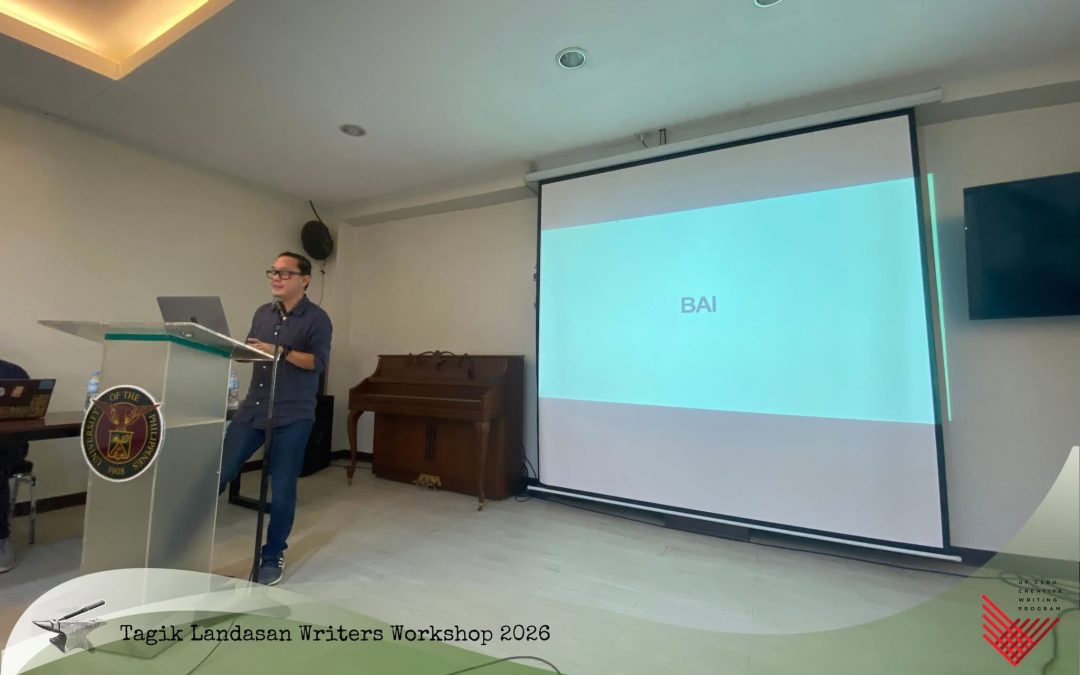
(𝘋𝘦𝘭𝘪𝘷𝘦𝘳𝘦𝘥 𝘥𝘶𝘳𝘪𝘯𝘨 𝘜𝘗 𝘊𝘦𝘣𝘶 𝘊𝘳𝘦𝘢𝘵𝘪𝘷𝘦 𝘞𝘳𝘪𝘵𝘪𝘯𝘨 𝘗𝘳𝘰𝘨𝘳𝘢𝘮’𝘴 “𝘛𝘢𝘨𝘪𝘬 𝘓𝘢𝘯𝘥𝘢𝘴𝘢𝘯 𝘊𝘞 𝘞𝘰𝘳𝘬𝘴𝘩𝘰𝘱” (𝘖𝘤𝘵. 19-20, 2026) by Asst. Prof. January Yap) | Photo courtesy: UP Cebu Creative Writing Program
What shrieked in the head of mathematician Archimedes who bolted the bathtub one warm afternoon in the streets of Syracuse, yelling “𝘌𝘶𝘳𝘦𝘬𝘢! 𝘌𝘶𝘳𝘦𝘬𝘢!”?
A few days earlier, the commissioned craftsman delivered the royal wreath to King Hiero II. But the king doubted if the smith had fully infused the entire raw material of gold into the piece, and so he asked Archimedes to check on it.
Pressed and puzzled by the task, Archimedes took his time in the public bath. Flopping anxious in the warm pool, the math wiz saw how the water level rose, relative to the weight and density of his body. At that instant, he thought he had found the formula to solve the King’s question, sending him in a fit of unbridled glee—in what has since then been called the “eureka moment.”
The term, attributed to Archimedes, would have its iterations in many apocryphal tales, one of those was that of Isaac Newton’s epiphanous moment of a fruit fall, and thus, eureka!, his theory around gravity.
“I have found it!” That’s what the Greek phrase means. An interjection that caps a very human moment, “eureka” might as well be the cry when a writer’s creative act finds an enthralling turn—a phrasal jolt, a suave slant, an incendiary crot, a psychic leap, a Byzantine conceit, and just about anything that is ineffably human that interferes in a very dispersive way within rigid text. Literature is full of that. The unsaid, the at once unwritten yet articulate, they are what gesture toward the thing we call literature.
When Charles Simic wrote Watermelon, he said, “𝘎𝘳𝘦𝘦𝘯 𝘉𝘶𝘥𝘥𝘩𝘢𝘴 𝘰𝘯 𝘵𝘩𝘦 𝘧𝘳𝘶𝘪𝘵 𝘴𝘵𝘢𝘯𝘥; 𝘸𝘦 𝘦𝘢𝘵 𝘵𝘩𝘦 𝘴𝘮𝘪𝘭𝘦 𝘢𝘯𝘥 𝘴𝘱𝘪𝘵 𝘰𝘶𝘵 𝘵𝘩𝘦 𝘵𝘦𝘦𝘵𝘩,” the dance is not in the bold curves and ligatures on white page.
The full sway transpires electric between the green watermelon on the fruit stand and the poet’s eye; between cut lines on a page to the reader’s gut. Something beyond math conspires to complete the poetry—end to end, object to poet to reader.
Note that before modernity bound this thing via ink on page and called it literature, it existed for centuries as sound, as phonemes in the age of orality. Of bards baring a ballad to the belle on the balcony. Shamans conversing with the elements; babaylans crooning at the healer moon. Meaning-making isn’t in the stiff shape of a word, but in the human utterance. But that’s getting ahead of the story.
One of my favorite writers, the physicist/novelist Alan Lightman (Einstein’s Dreams), in his essay “The Pendulum Experiment,” recalls how at nine years old he tried to prove a magazine article’s claim that the amount of time for a pendulum to swing is proportional to the square root of the length of its string. With an assembly of rudiments, the young Alan proved the proposition true. He wrote, “𝘐𝘵’𝘴 𝘦𝘯𝘰𝘳𝘮𝘰𝘶𝘴𝘭𝘺 𝘴𝘢𝘵𝘪𝘴𝘧𝘺𝘪𝘯𝘨 𝘵𝘰 𝘱𝘳𝘰𝘷𝘦 𝘴𝘰𝘮𝘦𝘵𝘩𝘪𝘯𝘨 𝘧𝘰𝘳 𝘺𝘰𝘶𝘳𝘴𝘦𝘭𝘧. 𝘐𝘵 𝘨𝘪𝘷𝘦𝘴 𝘺𝘰𝘶 𝘢 𝘧𝘦𝘦𝘭𝘪𝘯𝘨 𝘰𝘧 𝘱𝘰𝘸𝘦𝘳 𝘵𝘩𝘢𝘵 𝘺𝘰𝘶 𝘤𝘢𝘯 𝘥𝘪𝘴𝘤𝘰𝘷𝘦𝘳 𝘵𝘩𝘪𝘯𝘨𝘴 𝘰𝘯 𝘺𝘰𝘶𝘳 𝘰𝘸𝘯.”
“To dig a well with a needle,” Orhan Pamuk cites the ancient Turkish saying in his Nobel lecture. The epic patience of the writer, and the magical reward of spirits dropping by one’s desk to reveal a universe when the weary scribe is darkly in the void. When I read back my own works, I see that the best parts in them, at least for me, were written, I now recall, when the creative act was most uncreative, lackluster and lost, in crisis. But one does not abandon that taunting cursor on the screen in the moment of negotiating with a barnacled sentence, and then suddenly, as though an alternative self, a ghostly second-liner, takes over the job. “Punch the keys!” Forrester howls at the young Jamal in the film Finding Forrester.
Driving through a small alley in the slums one time, I screeched to a halt when a man, flushed and fiery, darted across the street, chasing and hurling his dinner plates at a cat. That scene would turn out to be the climax in a short story called “Ang Matuod nga Mipatay ni Ped Xing” (Ped Xing’s True Killer?) The pedestrian crossing in the fiction would be the downtrodden construction worker—crushed, following a partner’s ghosting and a job expulsion over an accident that destroyed an equipment. In the story, the raging man chasing the cat was screaming his heart out, “The bulldozer hit the grinder! The bulldozer hit the grinder!” The bulldozer and the grinder were worlds apart from the cat being chased at the moment, but somehow the metaphor spoke of the tonnage that fell on the poor worker’s heart by the twin tragedies.
Zoom out, needless to say it was slant about poor proletarian conditions. As Emily Dickinson wrote, “Tell all the truth, but tell it slant.” Hindsight is easy, but somewhere in the creative act of connecting the dots lies the enigmatic. Only a human being has the capacity, again to quote Dickinson, to “dazzle gradually.” Put AI in that act, chances are, you’d fall flat with a hackneyed wailing from the angry pedestrian—say, “Fuck you, friggin’ cat!”
To be in it, in those blazing seconds when the invisible hand of a seemingly strange double pounds on the keys. When the first self is surprised, bug-eyed, bones chilling, to find those slow words falling into place as though with a mind of their own. And yet the writer knows it is only his lone self in that void. The secret sadness, the shame, the quiet banquet morphing on white screen into language. That pretend assembly of human abstractions into words is by itself an indescribable process of euphoric revelry. A hell of a precious thing, to use the Cebuano poet Rene Amper’s words, “the bread I break with you is not just bread/It is the loaf I cannot give to a raging crowd.” That bread is the act of writing.
So what in the world are we bargaining for in this AI deal? Keep that out of reach, that dulling drug against the earnest push of a human writing. Why exchange your shot at a million eurekas for that cold, self-driving train barreling to the gas chamber? I’d run naked from the tub anytime of the day for a roadshow at the tiniest hint of that “best word in the best order” moment rising like warm water in my bath. Eureka! Yari ka!
It is in the persistent writing where the writer goes past the Rubicon to the real, honest-to-goodness craft life. Every writer worth his salt knows that. The difficult, yet rewarding act of writing eventually becomes neural wiring, a repetitive dopamine high that one cannot simply kick out of habit. Only poseur scribes, persistently boggled by the act, develops the confusing, highly messed-up, hate-love affair with writing, and thus feebly vulnerable to the sworn expediency of an automaton. But the true writer, in his grave calling, is downright stubborn. He writes. He is selfish. Hell he does not want any bot mouthing his task on his friggin’ behalf. I remember Rushdie’s word, “behalfism”! The act is the writer’s alone.
I have no love-hate affair with writing. Love-hate is the language of one who romanticizes it—to declare oneself a hero for sticking it out despite the duality. I don’t romanticize writing in the same way that I don’t romanticize breathing. We do breathe anyway because… But isn’t it that literature, by itself, already IS big data? Take the whole corpus of written text humankind had generated for centuries. Machine models read them as numbers, patterns, stiff logic: dog plus teeth equals dog dentures. What yields? Cliches. What poetic, random, sensory associations can be missed out by a machine trained against randomness.
All art thrives in habit of appreciating the whole as greater than the sum of its parts. A Gestalt understanding of things. Lev Kuleshov and Sergei Eisenstein proved that a century ago, and thus cinema. Meaning coded only in what emerges from sequence, montage. It’s that absence-presence binary. The absent railway in Magritte’s work is just as pronounced as the train that stuck out of the furnace.
Machines can never extrapolate what the human renders invisible. The computational nature of AI cannot catch what never, in the first place, amounted into visible text. It cannot read the unsaid ages of critical inquiry had developed a coding system so that as we expand our reading, we develop a mental “large language model,” as it were, though not in the mathematical sense. Monoliths. Myths and motifs. Life and the seasons. The hero’s journey. The quest for the holy grail. Man versus one-eyed giants. Knight fighting windmills. There’s a labyrinthine filing cabinet down the deep dungeon. The writer, consciously or unconsciously, gets the bug. The reading writer takes inspiration from writers who were just as intensely inspired and tainted by the ways of those who came before them, and so on and so forth, in straight, oblique and cyclic ways.
Even by writers one doesn’t know of, to recall Umberto Eco’s “Anxiety of Influence,” writers incorporating vague bits from even way too distant readings—past or future, doesn’t matter. The “temporality of memory,” he writes. Iambic pentameter, figures of speech, fiction elements, sound, rhythm, these are computational formulas no different from AI’s pattern-obsessed mining habits. Even the canons and their ideological practices silently whisper cognitive conditions as one write. Power watches over the shoulder of a clueless writer. The carceral creative.
If the novel form can discover what only the novel can discover, as Kundera would have it, can the novelist leave half the discovering to the AI-aided creative process? Can the AI-prompted novel discover what only the novel can discover? Can the discoverable be anticipated, conjured up by mathematical computation? Will it surprise? Can it churn out what is humanly irrational? And what will it say of impulses, indecisions, the quiet rage of characters emerging out of razed homes, surviving genocide? Will the math in action seize the anguish of a character who says “I’m fine,” when in fact he is not? What is discoverable only within machine logic remains inferior to what human memory can conjure? “Art is the daughter of memory,” yes, but memory is stored up in the five senses. AI has yet to invent the olfactory.
And what of Toni Morrison’s notion of the “invisible ink’? The duality of language work that leaves the writer’s inability to capture lived experience for readers to play the part of catching the ghostly, the “invisible ink of history” beyond the prose. “How can I say things that are pictures,” the slave girl asks in Beloved. “Language,” Morrison in her Nobel lecture says, “can never live up to life once and for all. Nor should it. Its force, its felicity is in its reach towards the ineffable.” Talk then of the ineffable anytime of the day and big data is nothing but puny. The invisible ink is that unreadable human register that is easily missed out in the mathematical compute of that large language model. The inferior scribe basking in aid of the almighty AI will be just that, replicating that algorithmic mediocrity, predictable patterns, no less boring than big data itself, unsurprising, devoid of that very human vulnerability, tentativeness.
Literature thrives on because it is inherently counter-cliché, parsimonious against the hackneyed hand of the computational. That is how we tell pulp from gold, from hack to true writing. Literature’s intertextual games are reshuffled by human hands, the novelist himself as “explorer of existence,” as Kundera writes. And, yet, as always, as Robert Hughes would have it, the “shock of the new.”
Kundera talks about composer Leos Janacek who broke conventional patterns, who realized that orchestral notes crumble “under the weight of superfluous notes.” Musical compositions follow technical patterns: thematic exposition, progression, variations, polyphonic work, all of which logically mechanical. Though music these days can be composed by a computer, there was always a kind of computer present in composers’ heads. “…in a pinch, they could write a sonata without a single original idea, simply by following ‘cybernetically‘ the rules of composition. Janacek (Jan na check), writes Kundera, dismantles the computer by deploying “harsh juxtapositions instead of transitions, repetition instead of variation, and always head straight for the heart of things: only the note that says something essential has the right to exist.”
Riff. Jazz. Human. Howl. Threading of crots. Coherence in fragments. Archipelagic movement. The chaos within heaving out a dancing star, thus spoke Nietzsche.
To break the computer! Boy, isn’t that the writer’s imperative, too? The cybernetic counterpart of literature is very much embedded in our literary traditions—the narrative patterns, the show-versus-tell advice, archetypes, and all the writing workshop razzmatazz. Even as we know that the young writer soon discovers the void that opens up post-workshop, in the real-world spelunking chase for perfect metaphors. The novel, too, writes Kundera, is “weighed down by technique,” and his own imperative is “Janacekian,” “to rid the novel of automatism of novelistic technique, of novelistic verbalism, to make it dense.”
That density has nothing to do with the material scratching on page. It’s the volume of the ineffable packed in a phrase, that whirlpool in a word, the universe in a sentence. And that again is beyond the purview of the artificially human.
“And miles to go before I sleep./And miles to go before I sleep.” Uncoached by human-led parsing, AI merely reads that dull, senseless repetition, a redundancy. The wonderfully human poet, on the other hand, knows what shrieks in the second wave—that cosmic, solitary distance before one reaches the self. It’s that backstory pathos.
You teach creative writing. Come from the position of introducing at once one of the most joyful and painful human acts there is. Never deprive eager beavers of their own eurekas by bringing in an automaton in class. There is something off in that. There is something ethically dubious in enacting the mechanical for efficiency. Literature grows only out of lived experience. The doubting human at the heart of it. What is humanly ambiguous and overwhelming. There is no shortcut to depth. Contemplation resists speed. Speed is the language of factories. Factories are never neutral. The young writing majors will have their whole lives to deal with that.
A workshop piece discovers the potentially monstrous self, the one the village raised, and yet the writer-self via language discovers an ontological safe space, stays in suspension, in a state of ethical tentativeness. A high place made accessible to the writer only by way of language. That is what creative writing is, an unburdening, a healing through language. In an age when human agency is under threat, creative writing must be how we hold the line.
Cancel bot use as we romanticize, no, celebrate the ever-sophisticated viscerality of the act. The ever-questioning nature of the humanities makes it a prime target against the evil narratives of big tech’s agenda for absolute power. At a time when the old tomes are digitized and burned, it will be a matter of time when power curates in absolute terms the tale of the human. The writer must remain stubbornly human in his creative agencies and fight the faux archives.
I’d be glad to periodize every batch in some future yearbook as belonging to that proud and glorious pre-AI age. If we have a period BC, Before Christ, by all means, let’s have a BAI, Before AI. Our old alma mater as being the last human bastion, in CW 101, down the banyan shade with Professor Jurrasic, he with the funny goatee. Meanwhile, let those little frogs leap into the still pond and discover for themselves that big splash to eternity.
What is essential is invisible to AI, in defense of old-school Creative Writing