
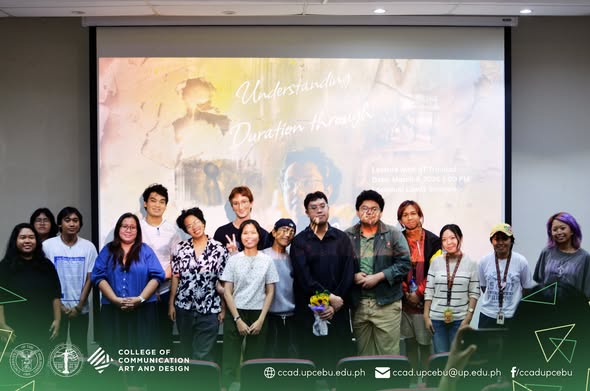
Last March 4, 2026, students and faculty convened at Lawak Sinehan for Understanding Duration through Moving Images, a lecture organized as part of Himoan’s Shared Spaces Programming. Himoan is the shared making space of Studio Arts at University of the Philippines Cebu. As a centralized platform, it streamlines studio booking, usage logs, operational guidelines, and space transparency to ensure the safe, accountable, and equitable use of collective facilities. Beyond infrastructure, Himoan also functions as a hub for knowledge exchange—extending its mandate from managing space to cultivating critical discourse around artistic practice.
The workshop formed part of this broader initiative. Conceived as an extension of the Himoan Shared Spaces hub, the session reinforced the relationship between shared resources and shared learning. By situating moving image literacy within this framework, the program emphasized that access to tools and studios must be accompanied by conceptual rigor and historical awareness. The workshop is resourced by JT Trinidad, a CCAD faculty member and filmmaker based in Cebu City, Philippines. Their work explores the intersections of queerness and geography, with a particular interest in landscapes as transforming and transformative spaces.
The lecture examined how moving image forms are informed by their histories and evolving pedagogies. Participants discussed the distinction between an image and a photograph, recognizing the constructed and mediated nature of images in motion. Central to the session was the exploration of time and duration—not as measurable units alone, but as aesthetic experiences shaped through editing, framing, sound, and spatial configuration.
The discussion further addressed added images and montage as mechanisms for generating meaning, and raised the foundational question of what constitutes cinema. Rather than defining cinema as purely visual, aural, or literary, the lecture framed it as an integrated field of images and sounds that structures perception. In this context, the concept of cinema fascism was introduced to encourage critical reflection on how moving images can direct attention and influence interpretation.
Through initiatives such as this workshop, Himoan affirms its role not only as a shared physical workspace, but as a shared intellectual space, strengthening responsible studio practice while advancing critical engagement with contemporary image-making.
For studio bookings and inquiries, contact Himoan Spaces at https://himoan.notion.site/.