
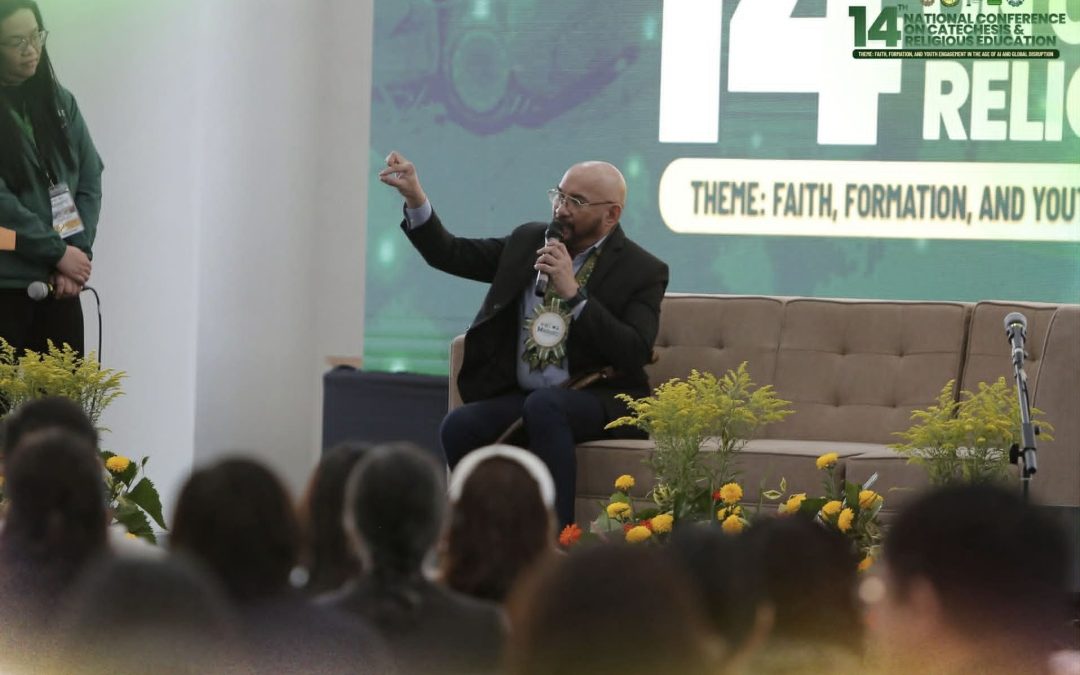
At the 14th National Conference on Catechesis and Religious Education, Dr. Gregg Lloren delivered a plenary talk that reflected on how the pandemic and new technologies continue to shape the way people live, relate, and understand the world.
In his talk, “Per aspera ad Magnum Anthropocenum (Through hardship, toward the Great Anthropocene)”, Dr. Lloren explained that the pandemic and the rise of digital technologies did not happen separately—they unfolded at the same time and influenced each other.
During the pandemic, people became more aware of their physical bodies. Simple things like breathing, distance, and contact became important and noticeable. At the same time, daily life moved online. Classes, meetings, and conversations happened through screens. While people stayed in one place physically, they were also constantly interacting in digital spaces.
According to Dr. Lloren, this way of living has not completely disappeared. Many people still experience a sense of being “slightly displaced,” where attention, presence, and space feel different from before.
He also pointed out that both the virus and technology spread through connection. They move across people and systems, creating changes along the way. These are not just disruptions—they also push people to adapt. Over time, small changes in behavior, perception, and relationships build up and reshape everyday life.
Dr. Lloren suggested that these changes can be understood as part of a broader process of transformation. This is not just about biology, but about how people experience and make sense of the world. As life becomes more complex and interconnected, it can feel difficult to fully understand—something he relates to the idea of the “sublime.”
To conclude, he offered a simple but meaningful direction: to stay connected—to oneself, to others, and to something greater, which may be understood as the Divine. In a time of ongoing change, this sense of connection remains essential.
Photos by the Center for Religious Education USJ-R