
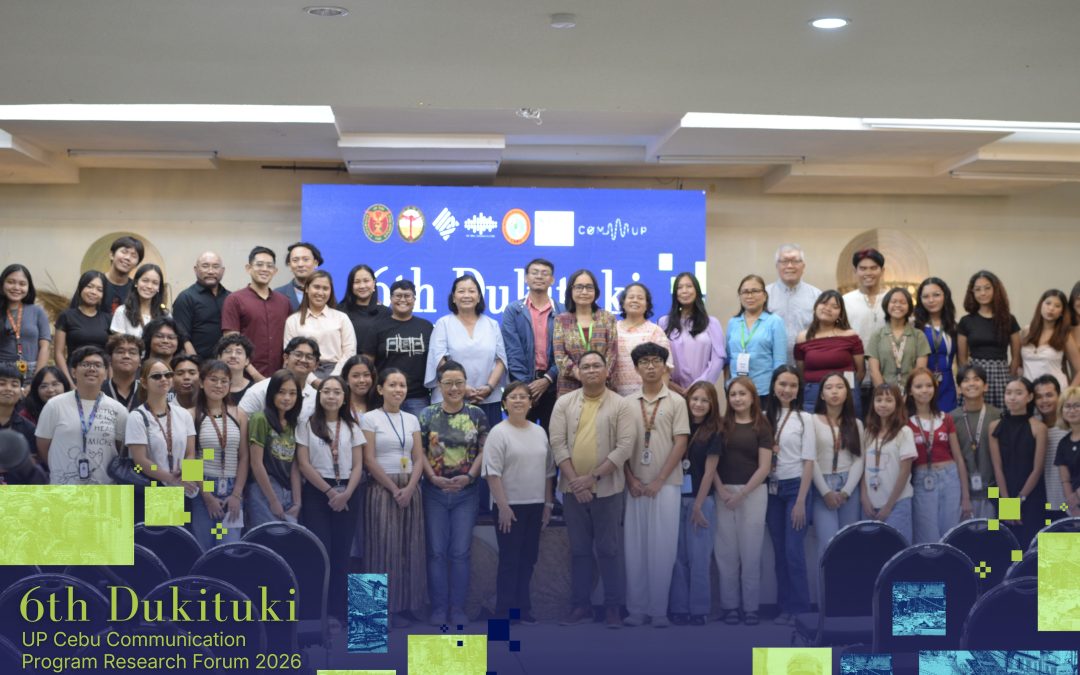
The Communication Program of UP Cebu formally opened the 6th DukiTuki: Communication Program Research Forum on May 6, 2026, bringing together scholars, practitioners, journalists, students, and community leaders for critical conversations on disaster and risk communication in Cebu. Anchored on the theme, “Communicating Risk, Living with Disaster: Voices, Vulnerabilities, and Futures in Cebu,” the forum highlighted the intersections of environmental vulnerability, governance, communication, and lived realities in disaster-prone communities.
Despite the disruptions caused by the declaration of May 6–8, 2026 as special non-working days in Cebu City due to the 48th ASEAN Summit, DukiTuki 2026 continued its onsite sessions as scheduled. Following Memorandum No. CLM 2025-033 and the Chancellor’s directive shifting classes and work arrangements online beginning noon of May 6, attendance was affected as students and offices adjusted to flexible and remote arrangements. Nevertheless, the forum proceeded with the coordinated onsite activities.
Day one of the forum
The forum began with the opening ceremonies, followed by welcome remarks from Dr. Crina Tañongon, Dean of the College of Communication, Art, and Design, who underscored the importance of communication in navigating increasingly complex environmental and social crises. A significant moment during Dr. Tañongon’s speech was the Symbolic Act of Collaboration between UP Cebu, the Cebu Provincial Disaster Risk Reduction and Management Office (PDRRMO), and Living Story Landscapes, which transitioned into a short ceremonial photo opportunity with Ret. Col. Dennis Pastor, chief of the Cebu PDRRMO, Chancellor Leo Malagar, and Ms. Sarah Queblatin, founder of Living Story Landscapes. Framed around the Filipino values of pagtambayayong and pagtinabangay, the ceremony emphasized solidarity and shared responsibility among the academe, government, and civil society in addressing disaster risk and resilience-building. Through the symbolic joining of plaques representing “Knowledge and Inquiry,” “Service and Protection,” and “Community and Culture,” the three institutions affirmed their commitment to collective action, community restoration, and the reimagining of futures shaped by disaster and recovery. The ceremony was then followed by an opening message from Chancellor Malagar, who emphasized the university’s role in fostering critical dialogue and community engagement amid pressing societal concerns.
The morning plenary sessions foregrounded scientific and institutional perspectives on disaster preparedness and environmental vulnerability. Dr. Jonnifer R. Sinogaya, Director of the Center for Environmental Informatics, delivered the first keynote presentation on understanding Cebu’s Environmental Vulnerabilities– Climate Systems, Data, and Hazard Projections. His talk examined how climate systems, hazard modeling, and environmental data can deepen public understanding of Cebu’s exposure to floods, extreme weather events, and long-term climate variability. He also highlighted the importance of translating scientific information into accessible and actionable knowledge for communities and policymakers.
Following this, Ret. Col. Dennis Pastor presented “Communicating Risk on the Ground: Disaster Preparedness and Response in Cebu.” Drawing from operational experience in disaster management, Pastor discussed Cebu’s current risk landscape, institutional preparedness systems, and the critical role of communication in disaster response and coordination. The session emphasized how effective communication practices shape preparedness, trust, and public action during emergencies. A talkback session moderated by Dr. Brisneve Edullantes from the Department of Biology and Environmental Science further expanded the discussions on science communication, governance, and local resilience-building.
The afternoon featured a series of parallel sessions showcasing student and faculty research across multiple themes related to disaster communication, media, culture, governance, and digital life. Presentations explored topics such as early warning communication, community-based disaster narratives, digital overreliance in risk communication, environmental knowledge among coastal communities, and media framing in digital spaces. Through these sessions, participants examined how disasters are experienced, narrated, and negotiated across institutional and everyday contexts.
One of the day’s major highlights was the third plenary session delivered by Alfredo A. Arquillano Jr., Municipal Mayor of San Francisco, Camotes, Cebu. In his talk, “The Purok System of San Francisco, Camotes: Strengthening Communication, Coordination, and Community Resilience,” Mayor Arquillano discussed the grassroots governance model that gained international recognition for its role in disaster risk reduction and community participation. He emphasized how localized communication systems and community coordination can strengthen resilience, especially in vulnerable and disaster-prone areas.
Originally scheduled as part of the afternoon program, Special Session 1: Wa’y Plastikay, a consultation on plastic waste, environmental justice, and collective responsibility, was unable to proceed due to the availability of invited speakers and facilitators. Despite this adjustment, conversations surrounding environmental accountability and disaster vulnerability remained present throughout the day’s discussions and presentations.
The first day concluded with Parallel Session G: Film Screening, featuring documentary and narrative works that explored disaster, displacement, and survival in the Cebuano context. Among the featured films was Sa Ilalom sa Tulay (Under the Bridge) by Januar E. Yap, which documented the aftermath of Typhoon Tino and the lived reality of a displaced couple living under the bridge. A student-produced film “Basig Ugma Na” also captivated the audiences’ attention through its clever and cinematic depiction of experiencing crisis, set inside a traditional lotto stall.
As DukiTuki 2026 opened its conversations on disaster and communication, the first day underscored the urgency of understanding risk not only through data and policy, but also through stories, relationships, and collective experiences. Amid schedule disruptions and shifting conditions across the city, the continuation of the forum itself reflected the adaptability and resilience that the event sought to examine, demonstrating how communication remains central to how communities prepare for, respond to, and live through disaster.
Day two of the forum
Building on the momentum of the first day, Day two brought together scholars, journalists, students, researchers, and practitioners to examine disaster communication not only as an institutional process, but also as an emotional, cultural, and deeply human experience.
The morning opened with a plenary session by Annie Perez-Gallardo, journalist and UP Cebu Communication faculty member, who delivered the talk on Community Journalism in times of Disaster and Crisis. Drawing from her experiences covering major disasters in Cebu, including earthquakes, typhoons, and environmental emergencies, Perez-Gallardo reflected on the enduring role of local journalism in documenting crises and informing communities. Her presentation examined the tensions faced by journalists working in disaster conditions; balancing urgency with verification, emotional proximity with ethical responsibility, and public service with personal vulnerability. By situating disaster reporting within the context of community journalism, the talk underscored how local narratives shape collective understanding, memory, and response during moments of uncertainty.
This was followed by Special Session 2: “Covering Crisis: The Mental Health Consequences of Disaster Reporting,” organized in partnership with STET Women in Cebu Media. Facilitated by Dr. Johnrev Guilaran, the lecture-workshop focused on the psychological toll of crisis reporting on journalists and media practitioners. The session highlighted how repeated exposure to traumatic events, disaster environments, and emotionally charged narratives can impact the mental health and well-being of reporters. Discussions centered on trauma-informed approaches to journalism, emotional resilience, and the importance of institutional support systems for media workers who often operate under intense pressure during disasters and emergencies.
The forum then transitioned into another series of parallel sessions featuring student and faculty research presentations. Discussions covered a broad range of topics including digital culture, media framing, identity performance, governance, community vulnerability, and participatory storytelling. These sessions reflected the Communication Program’s continued engagement with interdisciplinary and locally grounded scholarship, connecting broader theoretical frameworks to lived realities in Cebu and beyond. One of the featured sessions included analyses of social media narratives, fandom cultures, and digital identity performances, while others examined environmental communication, grassroots resilience, and the communicative dimensions of governance and displacement.
The afternoon plenary featured Sarah Queblatin, regenerative design specialist, cultural worker, and founder of Green Releaf Initiative. In her talk, “Restoring and Re-storying from Resilience to Regeneration,” Queblatin explored trauma-informed and regenerative approaches to disaster response and community healing. Moving beyond conventional notions of resilience, her presentation emphasized the role of cultural memory, imagination, and storytelling in rebuilding communities affected by climate and conflict-related disasters. Drawing from her work in ecopsychology, expressive arts, and regenerative design, she encouraged participants to rethink disaster recovery not merely as survival, but as a process of restoration, transformation, and collective reimagining.
Another major highlight of the second day was the plenary presentation of Dr. Johnrev Guilaran titled “The Psychological Dimension of Disaster Communication.” Drawing from psychology, disaster studies, and communication research, Dr. Guilaran examined how disasters shape human emotions, cognition, and behavior, and how communication processes significantly influence these psychological responses. His presentation emphasized that disaster communication extends beyond the transmission of warnings and safety information. Effective communication, he explained, also plays a critical role in promoting psychological resilience, collective efficacy, and community recovery. By discussing evidence-based communication strategies, Dr. Guilaran highlighted how communication can encourage adaptive behaviors, support sensemaking during crises, and cultivate hope amid uncertainty and disruption.His talk ultimately reinforced the importance of approaching disaster communication not only as a technical or institutional concern, but also as a deeply human and emotional process that shapes how communities endure, respond to, and recover from crisis.
Following the plenary presentation of Dr. Guilaran, the forum transitioned into a panel discussion that brought together perspectives from journalism, psychology, film, and regenerative community work. Moderated by veteran journalist Nini Cabaero, the discussion featured Sarah Queblatin, Januar E. Yap, and Dr. Guilaran himself. The panel expanded the conversations on disaster communication by reflecting on the emotional, cultural, and human dimensions of crisis documentation and recovery. Drawing from their respective fields, the speakers discussed the role of storytelling, media, mental health, and community-centered practices in shaping public understanding of disaster and resilience.
The forum concluded with a synthesis delivered by Dr. Gregg Lloren, Communication Program Coordinator, who reflected on the key insights and recurring themes that emerged throughout the two-day forum. Drawing from discussions on disaster communication, media, governance, psychology, environmental vulnerability, and community resilience, Dr. Lloren emphasized the urgency of critically examining how realities are constructed, circulated, and negotiated during moments of crisis. Central to his synthesis was the concept of the “reality machine” — the systems, institutions, platforms, and communicative processes that shape public perception and collective understanding. In the context of disasters, he noted, communication does not merely report reality but actively participates in producing meanings, framing risks, and influencing how communities respond to uncertainty and vulnerability.
As DukiTuki 2026 came to a close, the forum reaffirmed the importance of communication in understanding disasters beyond statistics and infrastructures. Across plenary sessions, research presentations, and community dialogues, the forum highlighted how stories, emotions, knowledge systems, and collective action shape the ways communities prepare for, respond to, and recover from crisis.
Now in its sixth year, DukiTuki continues to serve as the annual research forum of the UP Cebu Communication Program—creating space for critical inquiry, creative engagement, and public conversations that respond to the urgent realities of contemporary society.