
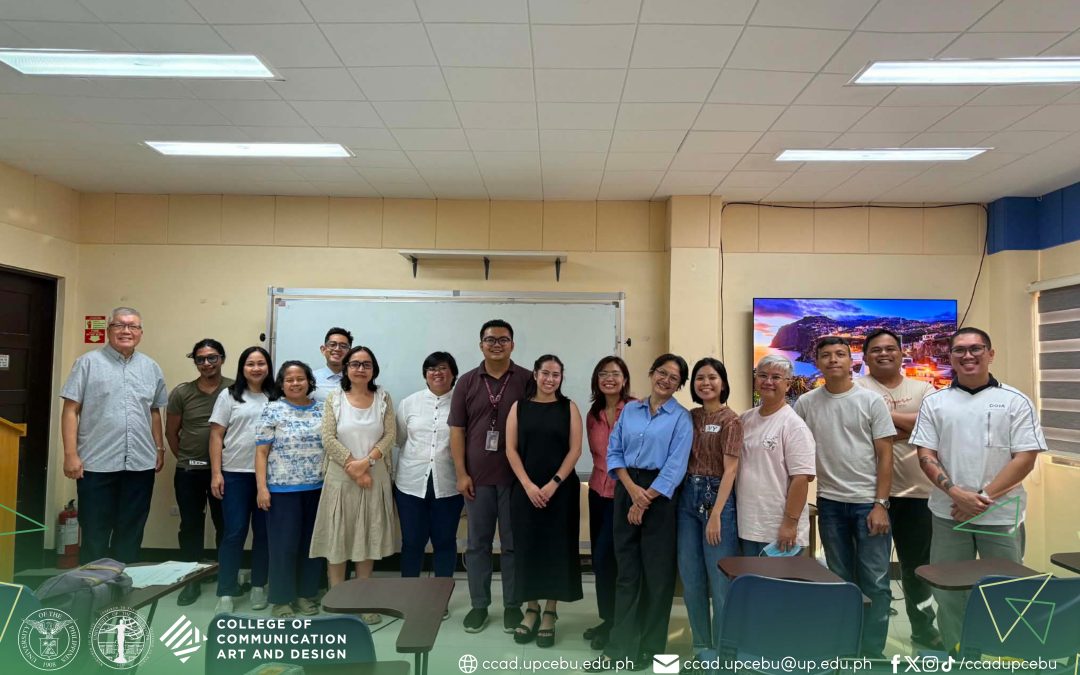
Continuing its commitment to strengthening curricular coherence, continuous curricular improvement, and outcomes-based teaching, faculty members of the College of Communication, Art and Design (CCAD) participated in the third session of FACETS 2.0: Faculty Advancement and Continuing Education in Teaching Series organized by the UP Cebu Teaching and Learning Resource Center (TLRC) on April 29, 2026 at the School of Management Room 102.
Building on the Program Learning Outcome (PLO)–Course Learning Outcome (CLO) alignment work initiated in the previous sessions, and also accompanied by previous speakers, Asst. Prof. Sean Policarpio and Asst. Prof. Jeraline Gumalal, FACETS 2.0 Session 3 shifted the focus toward assessment design within the Outcomes-Based Education (OBE) framework. Faculty members revisited their CLOs, identified appropriate Teaching and Learning Activities (TLAs), and examined how assessment practices may meaningfully capture evidence of student learning.
Working collaboratively in course-level groups, faculty members reviewed and refined the alignment between CLOs, TLAs, and assessment strategies across selected courses. Discussions centered on authentic assessment, rubric development, course-level harmonization, and the creation of clearer and more coherent assessment practices across sections while maintaining disciplinary and creative flexibility.
As part of the workshop process, faculty members also mapped different assessment approaches according to purpose, learning activities, and grading strategies. Discussions explored formative and summative assessment approaches, including interest-based and inquiry-based activities, integrative practice, authentic assessment, project-based learning, capstone outputs, and service learning.
Faculty reflected on how activities such as think-pair-share, show-and-tell, reflection papers, presentations, proposals, media production, and research synthesis may be aligned with holistic and analytic rubrics to better capture student learning, creativity, participation, and critical engagement.
Among the workshop outputs examined during the session were syllabi and alignment matrices from courses such as COMM 104: Communication Theory and FA 10-Visual Perception, where faculty mapped learning outcomes to classroom activities, formative and summative assessments, and rubric criteria. These exercises emphasized how assessment may move beyond grading toward supporting meaningful learning, critical reflection, creative practice, and disciplinary application.
The session forms part of CCAD’s continuous curricular improvement initiatives across its Communication, Product Design, and Studio Arts programs. Through collaborative reflection on outcomes, pedagogy, and assessment, FACETS 2.0 continues to provide a space for faculty to strengthen curricular coherence, refine teaching practices, and respond to the evolving demands of higher education and disciplinary practice.