
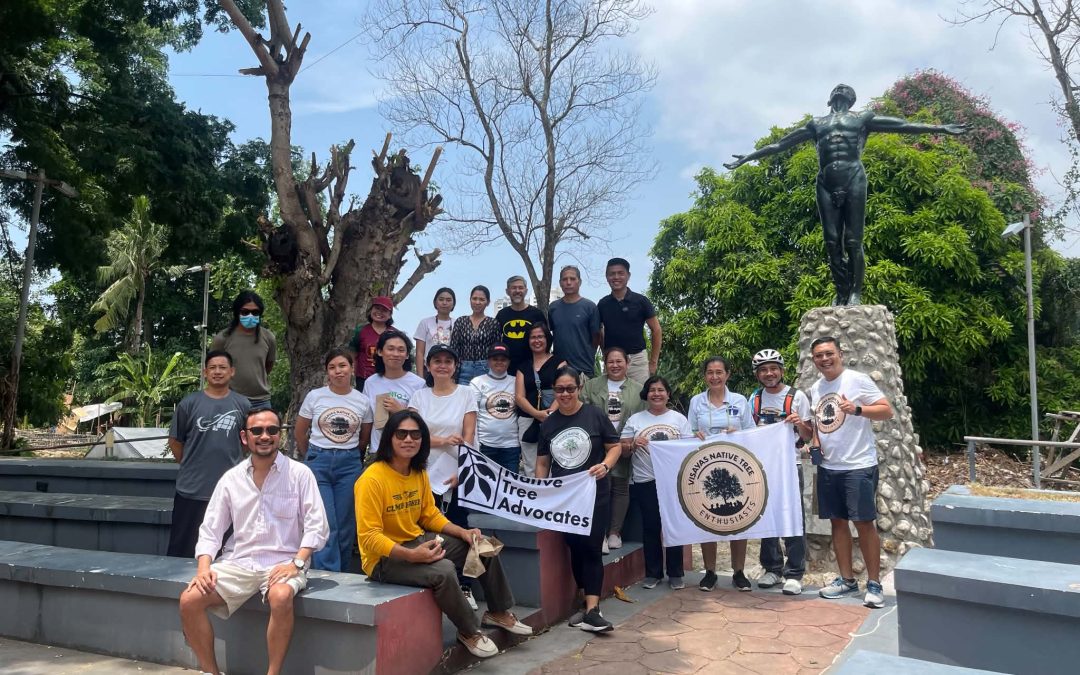
CCAD Faculty and Staff with the Visayas Native Tree Enthusiasts | Photo Courtesy: Asst. Prof. Jay Jore
The College of Communication, Art, and Design (CCAD) welcomed members of the Visayas Native Tree Enthusiasts (VNTE) for a day of seed exchange, storytelling, and the identification and tagging of native trees across the UP Cebu campus on September 5, 2026.
Among the seeds exchanged were Antipolo, Bagoadlau, and Magkono, among others. The seeds were gathered from different parts of the Visayas and Mindanao.
For the group, every seed carries the DNA of a story and the experience of where it was found, who gathered it, and the landscape from which it came.
VNTE member Bretha Villaflor said that tree enthusiasts like, constantly looking up into trees for mature fruits or pods and bending down to collect those that have fallen become part of the practice of gathering and preserving native seeds.
“Hangad, duko,” said Villaflor.
The seeds are then brought to monthly exchange hubs, where they are shared among fellow enthusiasts.
The seed exchange was complemented by a storytelling session and germination protocol led by artist and curator Asst. Prof. Jay Nathan Jore and VNTE Executive Director and biologist Maria Gala Marcellones Enero.
Jore emphasized the role of storytelling, art, and culture in making science accessible and relatable, while Enero highlighted the importance of interactive and experiential learning, where participants can observe and engage directly with actual seeds and trees.
Following the seed exchange, Enero led a campus tree walk, identifying and tagging around 20 native trees and plants on the UP Cebu campus.
Among them were Narra, Banaba, Albizia, Kalokoy, Awom, Antipolo, Is-is, Bolbolan, Tal-ot, Dakit, and Tugas.
Bernard Restificar, founder of Oikos Orchard and Farm, also shared the Laudate Deum Pocket Forest initiative of the Archdiocese of Cebu, which promotes pocket forests in parishes as a concrete response to the climate and ecological crisis.
VNTE serves as the project’s technical arm, contributing expertise in native trees, seed collection, identification, and ecological knowledge.
“This is part of CCAD’s broader aspiration to contribute to Cebu’s ecological regeneration by cultivating biodiversity and ecological microclimates within the urban campus,” said CCAD Dean Crina Tañongon.
CCAD extends its sincere appreciation to the Office of the Vice Chancellor for Administration, the Office of the Campus Architect, the Safety and Security Unit, and the Office of the Chancellor for their support in making the activity possible.
Special thanks also go to CCAD Support Staff Erniel Dela Torre for preparing the venue and handling logistics, and to Administrative Staff Cecilio Labajo and Jonareza Arinaza for their continued support and assistance throughout the CCAD Biospace activities.
The initiative resonates with CCAD’s vision for its Community Biospace, a living laboratory where ecological knowledge, creative practice, community engagement, and learning intersect.