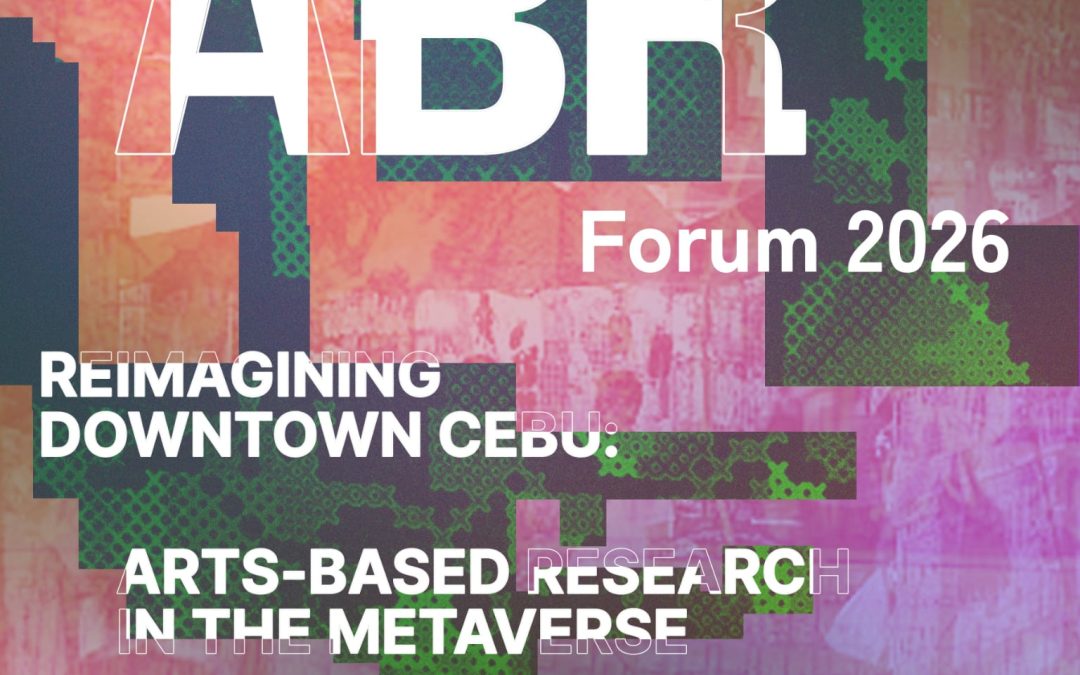
Poster Credits: Instr. Greys Compuesto
The College of Communication, Art and Design, in partnership with UP Open University and Japan’s Meiji University, will hold a three-day forum to explore urban livability, sustainability, and climate resilience through art and intercultural dialogue.
From November 3 to 5, 2026, the “2nd Meiji × University of the Philippines Arts-Based Research (ABR) Forum” will carry the theme “Reimagining Downtown Cebu: Arts-Based Research and Intercultural Dialogue for a More Livable City.”
The forum explores how artistic expression and intercultural exchanges can generate new ways of understanding urban environments and imagining more sustainable urban futures.
Through photography, drawing, storytelling, and other creative practices, participants will use arts-based research (ABR) to examine the experiences, memories, and environmental realities of people and places beyond conventional research approaches.
The initiative brings together Filipino and Japanese participants to examine what makes a city livable, drawing from their experiences of urban spaces, public transportation, cultural heritage, extreme heat, and flooding.
The forum’s guiding question asks: “Drawing from our experiences in Cebu and Japan, how can we artistically reimagine downtown Cebu as a more livable city: comfortable, walkable, welcoming, sustainable and resilient?”
The forum will feature three interconnected activities: an ABR forum, an urbanity tour of downtown Cebu, and an immersive art workshop.
On November 3, participants will engage in discussions and hands-on activities on arts-based research. Meiji students will also lead ABR mini-practices for UP faculty members and students, introducing creative approaches to inquiry and knowledge production.
On November 4, participants will embark on a guided walking tour of downtown Cebu, examining the city’s built environment, public spaces, transportation systems, and cultural heritage. The tour will include stops in San Nicolas, Pasil, Taboan, Carbon Market, Plaza Independencia, Colon, and other historic areas.
Cebu’s experience of severe flooding during Typhoon Tino in November 2025 will serve as a point of reflection as participants compare climate adaptation approaches in the Philippines and Japan.
The fieldwork will encourage participants to reflect on urban livability and climate resilience, including how cities respond to flooding and extreme heat while preserving their cultural identity.
On November 5, participants will transform their observations and intercultural exchanges into collaborative artworks during the Immersive Lab workshop.
Working in mixed groups, students will create artworks using various media, including drawing, painting, photography, collage, poetry, and other creative forms.
These works will then be extended into a shared virtual exhibition through FrameVR, a browser-based metaverse platform that allows users to collaboratively create and explore three-dimensional spaces.
The virtual exhibition, also titled “Reimagining Downtown Cebu,” will feature artistic visions of greener streets, flood-resilient public spaces, shaded pedestrian areas, and community-centered urban environments that preserve Cebu’s cultural heritage while adapting to environmental challenges.
By bringing together participants from the Philippines and Japan, the initiative creates opportunities to exchange perspectives on urban design, climate adaptation, and the relationship between people and their environments.
The 2nd Meiji × UP ABR Forum will conclude on November 5 with a closing program at the UP Cebu Office of the International and Cultural Affairs (OICA) Museum, featuring group presentations, performances, and the awarding of certificates of participation.
The forum is organized by UP Cebu CCAD, UP Open University, and Meiji University, with support from the Cebu City Rizal Library, UP Cebu High School Rondalla, and UP Cebu OICA Museum.
UP Cebu, Meiji University, UPOU to ‘reimagine’ downtown Cebu through arts-based research