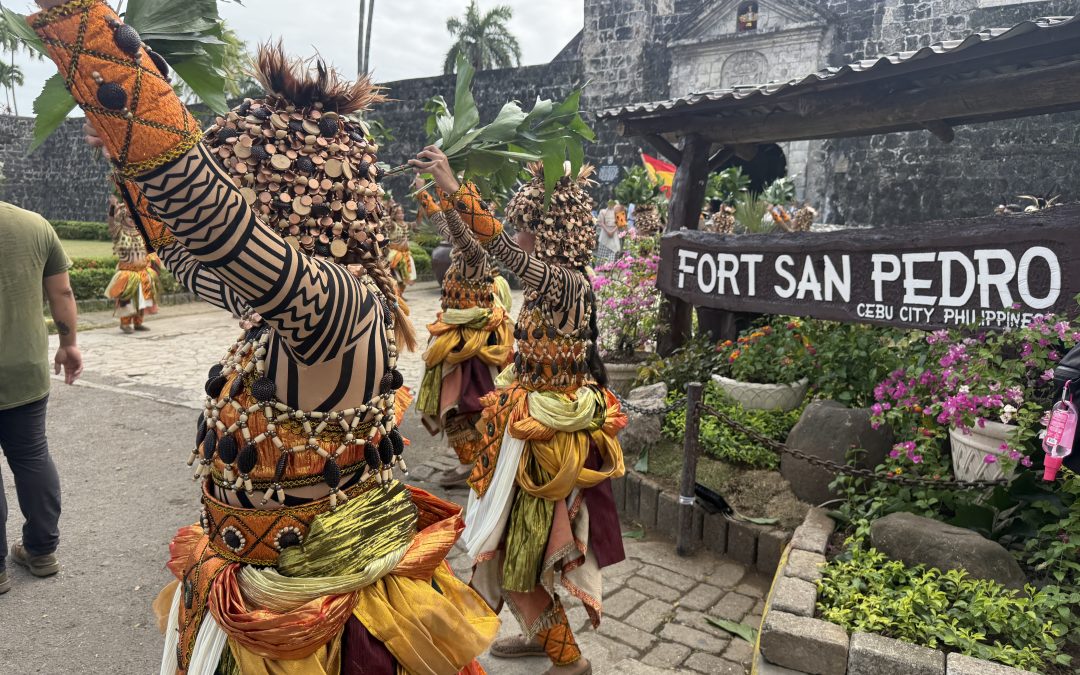
The Fort San Pedro is one of the stops for the Urbanity Walk | File Photo
Faculty members and students from the University of the Philippines Cebu, Japan’s Meiji University, and UP Open University are set to explore the history, heritage, and everyday lifeways of downtown Cebu today through the Urbanity Walk.
An ethnographic activity under the 2nd Meiji × UP Arts-Based Research (ABR) Forum 2026, the walk is titled “Walk Cebu! From San Nicolas to the Capitol.” It will take participants through 22 stops across downtown Cebu, encouraging them to examine how the city’s historical and cultural landscapes shape its present-day urban life.
The activity is part of the three-day forum, which runs from November 3 to 5 under the theme “Reimagining Downtown Cebu: Arts-Based Research in the Metaverse.”
The collaborative initiative brings together the three universities to explore how creative practices and immersive technologies can generate new ways of understanding and imagining urban futures.
Using a field guidebook and walking map, participants will begin in San Nicolas and proceed toward the Cebu Provincial Capitol, passing through four historical and cultural districts: Gremio de Naturales, Ciudad de Cebu, Gremio de Mestizos de Sangley, and American Cebu.
The route includes significant landmarks and everyday urban spaces such as the Pasil Fish Port and Market, Carbon Market, Cebu Metropolitan Cathedral, Colon Street, Cebu Normal University, Fuente Osmeña Circle, and the Cebu Provincial Capitol.
Beyond familiar landmarks, the walk invites participants to observe the city through an ethnographic lens, paying attention to its architecture, public spaces, food markets, transportation systems, and the communities that continue to shape its identity.
The activity reflects the interdisciplinary approach of arts-based research, which uses creative practice as a means of inquiry, dialogue, and knowledge production.
In her opening speech yesterday, UP Cebu CCAD Dean Crina Tañongon emphasized the value of bringing together different disciplines and perspectives to understand complex realities.
“Art can be valued for its own sake—for its beauty, expression, and ability to move us. But it can also serve society, become a way of asking questions, and generate knowledge about realities that are often difficult to capture through conventional research methods. This is what makes Arts-Based Research particularly exciting: art as inquiry, art as dialogue, and art as imagination,” Tañongon said.
She noted that collaboration across disciplines and cultures can open new possibilities for research and creative work.
“Perhaps this is where interdisciplinarity truly begins—not simply by putting disciplines together, but by cultivating respect for one another’s practices, knowledge, and cultures, and by being willing to learn from each other,” Tañongon added.
The forum also explores how arts-based research can intersect with science, communication, and immersive technologies to examine urban challenges such as climate change, flooding, and livability.
Through UP Open University’s expertise in immersive technologies, the collaboration seeks to translate observations and exchanges into creative representations of alternative urban futures.
For Tañongon, these collaborations are not simply a means to produce research outputs but opportunities to imagine new possibilities.
“Collaboration is not merely a means to an end; it is itself a creative process that makes new ideas, new possibilities, and new futures imaginable,” she further said.
Through the Urbanity Walk, the forum seeks to strengthen intercultural and interdisciplinary collaboration through arts-based research and creative engagement with the city.
The forum is organized by UP Cebu CCAD, UP Open University, and Meiji University, with support from the Cebu City Rizal Library, UP Cebu High School Rondalla, and UP Cebu OICA Museum.
Arts-based research forum to explore Cebu’s culture, heritage through ‘Urbanity Walk’