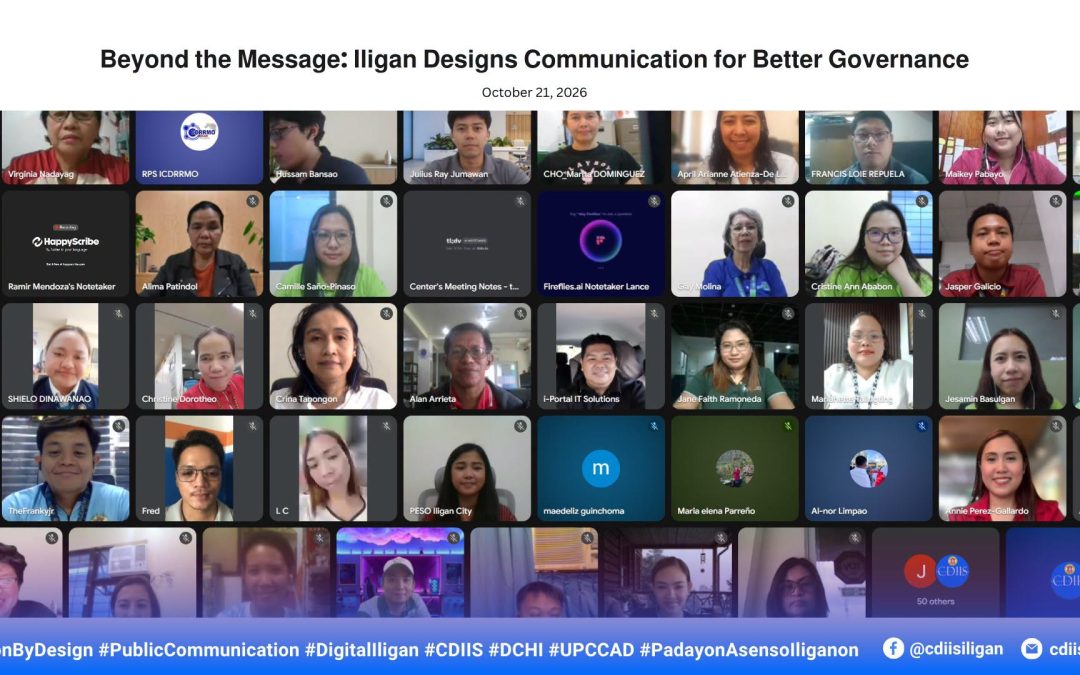
Communication by Design Governance Masterclass | Photo Courtesy: CDIIS
The College of Communication, Art, and Design (CCAD) brought its expertise in organizational and strategic communication to local governance through the Communication by Design for Governance Masterclass, organized by the City Government of Iligan on October 21, 2026, via Google Meet.
CCAD Dean Asst. Prof. Dr. Crina E. Tañongon and Asst. Prof. Annie Perez-Gallardo served as resource speakers for the online masterclass, organized through the Center for Digital Iligan, Innovation and Sustainability (CDIIS) and the Digital Creatives Hub Iligan (DCHI), in partnership with CCAD.
Anchored on the theme “Clear Messages. Informed Citizens. Innovative Solutions. Better Governance,” the masterclass brought together participants from city government offices, national agencies, academic institutions, the private sector, and community organizations.
It explored how communication can strengthen public trust, improve coordination, and make government services more responsive.
Tañongon opened the discussions with a session on organizational communication, emphasizing that effective public service requires more than simply sharing information.
Government offices must establish clear communication channels, define responsibilities, coordinate decisions, and ensure that citizens’ concerns receive appropriate responses.
Drawing on sociologist Max Weber’s concept of bureaucracy, Tañongon explained how systems designed for efficiency can become restrictive when offices operate in silos.
She underscored the importance of addressing institutional processes rather than placing the burden of communication failures on individuals.
“If problems are systemic, solutions must also be systemic,” Tañongon said, highlighting the need for government institutions to strengthen internal communication and accountability to better serve the public.
Meanwhile, Perez-Gallardo delivered the session “Beyond the Message: Strategic Communication for Public Trust and Impact,” focusing on the importance of designing public information around the needs, contexts, and capacities of intended audiences.
Using examples such as weather advisories and government announcements, she demonstrated how technical language and information-heavy messages can limit public understanding when they are not translated into clear, accessible, and actionable communication.
“We want outcomes more than the output,” Perez-Gallardo said.
She also emphasized that strategic communication must be purposeful, planned, and audience-centered.
Rather than measuring success solely through the number of social media posts or materials produced, communicators should assess whether their efforts help people understand issues, make informed decisions, and participate in public affairs.
The masterclass also featured Julie Anne Baculio, team leader of the Strategic Communication and Creative Unit of the Department of Science and Technology (DOST) Region X, who discussed science communication and the responsible presentation of scientific information, data, and risks.
CDIIS Head Paul Hui Lagura, who also chairs the Northern Mindanao Creative Industries Development Council, opened the program and facilitated the synthesis, connecting organizational, strategic, and science communication with public communication practices. City Administrator Dr. Darwin J. Manubag also joined the session.
During the open forum, participants discussed responding to misinformation about government programs, reaching communities with limited internet access, choosing appropriate languages for public information, and navigating the influence of social media algorithms on public understanding.
For UP Cebu CCAD, the engagement reflects the college’s commitment to bringing communication expertise beyond the classroom and into partnerships that support public service, civic participation, and community development.
CCAD Dean, Faculty Lead Iligan Masterclass on Communication and Governance