
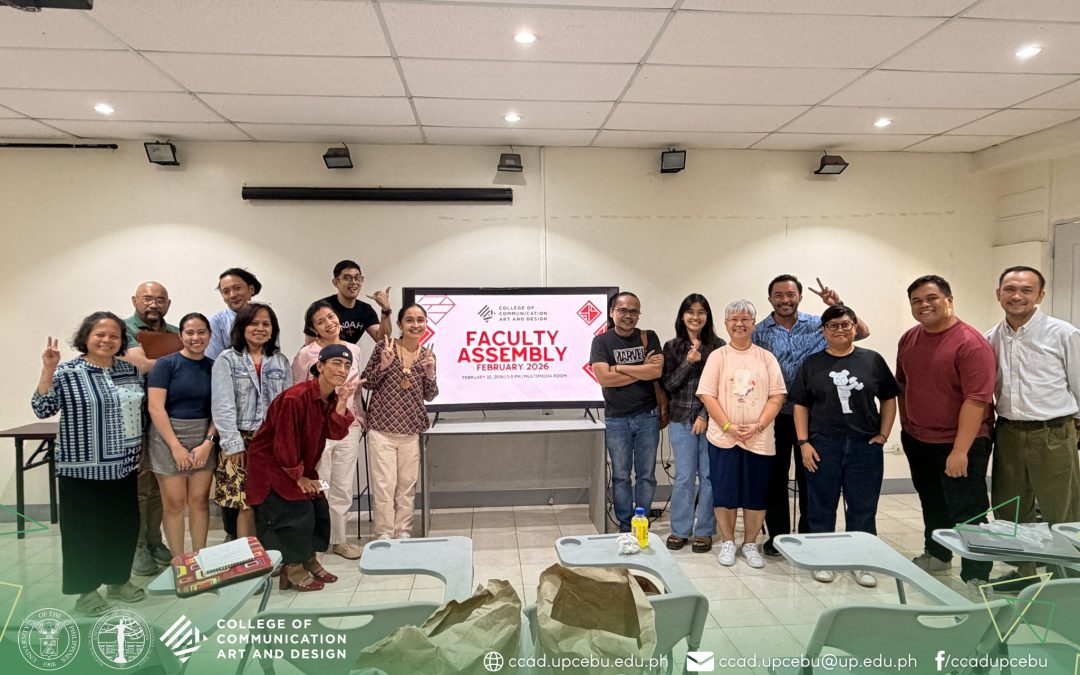
The second CCAD Faculty Assembly of this year convened on February 25, 2026, gathering faculty members in a productive afternoon of reflection, planning, and collective decision-making for the College’s continuing growth.
The Assembly opened with updates on program and committee matters, including the reconstitution of the CAPC and developments in PAPC formation across programs. The faculty also approved the minutes of the previous meeting and discussed key improvements in facilities, registration processes, and academic coordination to better support both students and instructors.
A major highlight of the afternoon was the report on the recently concluded External Quality Assurance (EQA) Review. The presentation emphasized the College’s strengths—particularly its supportive learning environment and positive feedback from alumni and employers—while outlining clear directions for continuous improvement. Among the recommendations were the refinement of curricular tracks, standardization of syllabi and assessment tools, modernization of facilities, and stronger alumni and industry engagement.
The Assembly also revisited goals from the first session of FACETS 2.0, underscoring outcomes-based education, alignment of Program Learning Outcomes (PLOs) and Course Learning Outcomes (CLOs), and the integration of higher-order thinking skills across core courses. Faculty were encouraged to ensure that syllabi are clearly OBEdized by the end of the semester, reinforcing CCAD’s shared vision for rigorous and responsive instruction.
In institutional updates, the PIO Team presented the soon-to-be-launched revamped CCAD website, designed by Product Design Instr. Kriztel Camalongay. The new platform will unify program information, blog posts, faculty profiles, and essential links into one accessible digital hub. Faculty members will soon be invited to update their profiles and contribute to the College’s growing online presence. The call for volunteers for the PR and Strategic Communications Team was likewise reiterated, positioning it as a key initiative to strengthen industry linkages and provide meaningful practicum opportunities for students.
The Assembly also approved the Automated Reservation System for the CCAD MediaLab, a Multimedia Laboratory, and the Himoan Shared Spaces online hub, both designed to streamline reservations, improve accountability, and modernize resource management. Plans for Workshop 3 renovations and discussions on the TLRC extension room further reflected the College’s ongoing efforts to cultivate safe, functional, and future-ready learning spaces.
The meeting concluded with announcements of upcoming academic and extension initiatives, including the MANGO Workshop on immersive making in collaboration with international partners, a faculty forum on teaching in the age of Generative AI, and the CCAD Convocation of Scholars.
More than a routine gathering, the Faculty Assembly reaffirmed CCAD’s shared commitment to quality assurance, curricular coherence, digital innovation, industry engagement, and community responsiveness. Through collaborative leadership and active faculty participation, the College continues to move forward—strengthening its programs, enriching student learning, and building a dynamic academic community grounded in excellence and service.