
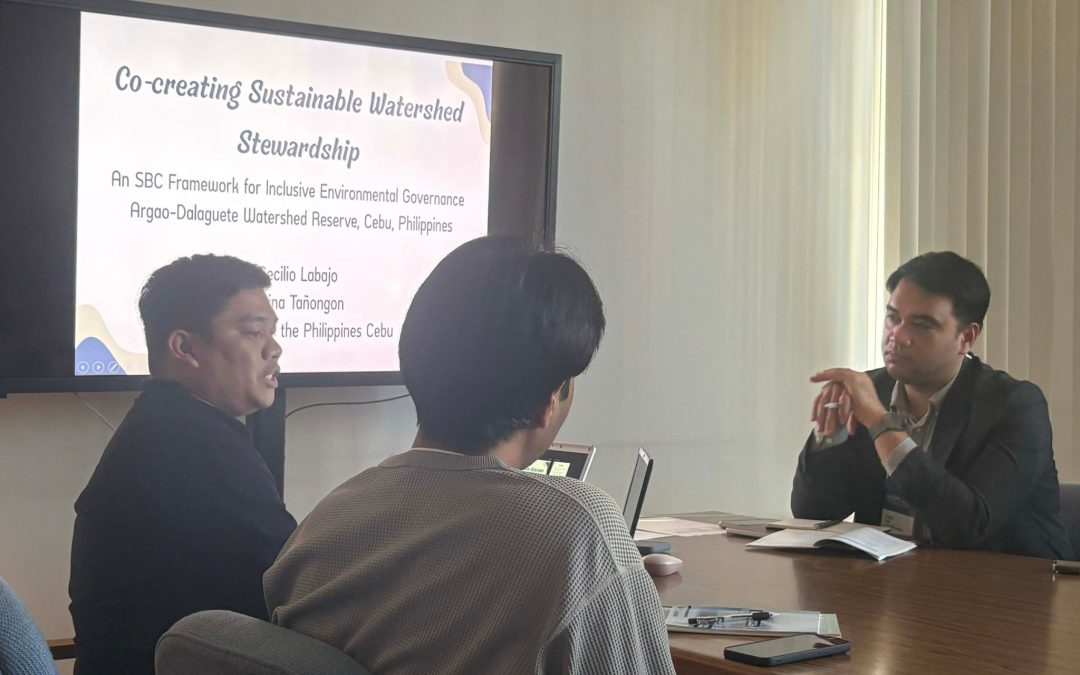
Cecilio “Celio” Labajo, a valued member of the administrative staff of the College of Communication, Art, and Design (CCAD), UP Cebu, presented at the NERPS 2026 International Conference on Peace and Sustainability held at the United Nations University (UNU) Headquarters in Tokyo, Japan.
The conference was jointly organized by the Network for Education and Research on Peace and Sustainability (NERPS) at Hiroshima University and the United Nations University, gathering scholars and practitioners from around the world to discuss research and initiatives advancing peace, sustainability, and global cooperation.
Celio presented the study “Co-creating Sustainable Watershed Stewardship: An SBC Model Grounded in Inclusive Communication, Trust, and Community Knowledge in Cebu, Philippines,” with Dr. Crina E. Tañongon as co-author, under the session “Peace, Justice and Strong Institutions.”
The study draws from the WWF-funded Knowledge, Attitudes, and Practices (KAP) assessment conducted in Argao and Dalaguete, Cebu from February to September 2025, focusing on communities within the Argao–Dalaguete Watershed Reserve. The research examines how communities understand watershed protection and proposes a Social and Behavior Change (SBC) model that emphasizes trusted communication, culturally grounded narratives, and community participation as pathways for sustained watershed stewardship.
Celio served as Field Coordinator of the WWF-supported research team that conducted fieldwork, community engagement, and data gathering in Argao and Dalaguete to inform water-resource management and watershed governance. The project was led by Dr. Crina E. Tañongon, with Field Supervisors Asst. Prof. Maurice Jitty Villaester and Asst. Prof. Dominic Yasay, and Statistician and Instrument Consultant Asst. Prof. Raden Gerald Agustin of the Statistics Program, University of the Philippines Cebu College of Science.
His participation in the international conference reflects the collective work of the research team and demonstrates how locally grounded environmental research from Cebu contributes to global conversations on sustainability and peace.
More importantly, Celio’s presentation reflects CCAD’s approach to research as inclusive and participatory where faculty and staff work together as a team in generating knowledge for public service and environmental stewardship. At CCAD, research is not only produced in the classroom or by faculty alone; it is built collaboratively, recognizing that meaningful knowledge emerges from shared work, community engagement, and collective commitment to the public good.