
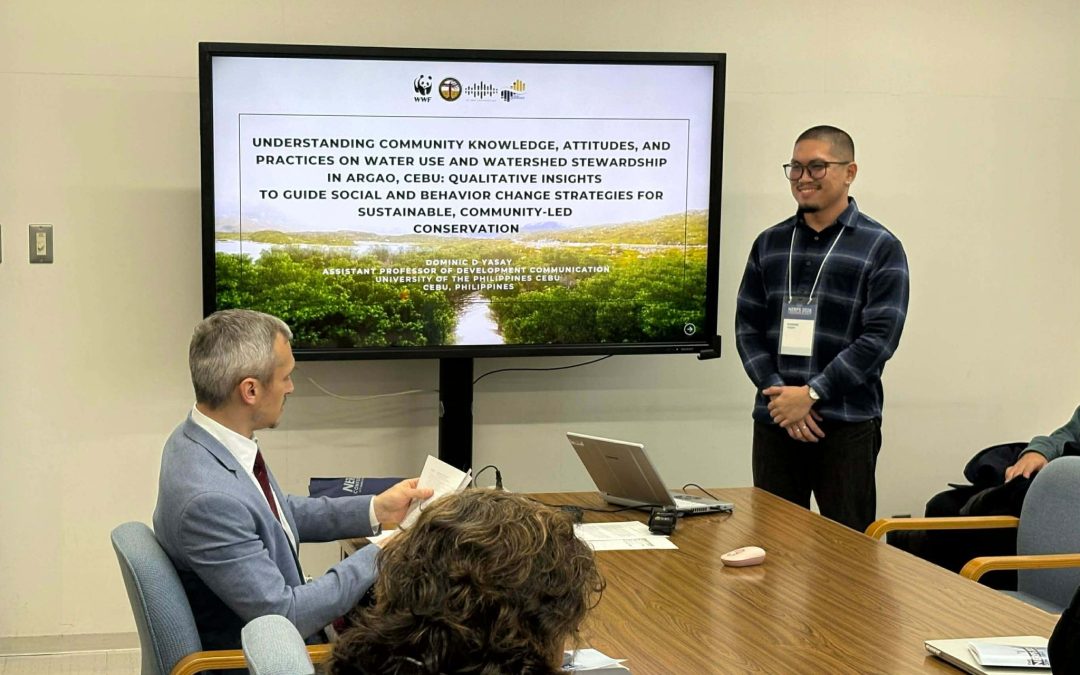
Assistant Professor Dominic D. Yasay of the Communication Program contributed to international discussions on Social and Behavior Change Communication (SBCC) and localized environmental governance at the Network for Education and Research on Peace and Sustainability (NERPS) International Conference 2026, held at the United Nations University in Tokyo, Japan on March 6, 2026. His paper was part of Session 4.6: Sustainable Cities and Communities, which examined community-based approaches to sustainability and environmental governance.
Funded by the Worldwide Fund for Nature (WWF) Philippines, his study, “Understanding Community Knowledge, Attitudes, and Practices on Water Use and Watershed Stewardship in Argao, Cebu: Qualitative Insights to Guide Social and Behavior Change Strategies for Sustainable, Community-Led Conservation,” engages broader conversations on how communication strategies can strengthen locally grounded watershed stewardship.
Focusing on communities surrounding the Argao–Dalaguete Watershed Reserve in Argao, Cebu, the research examines how residents understand water use and watershed protection within the context of everyday life. Through focus group discussions with residents, farmers, barangay officials, and members of people’s organizations from upland communities, the study surfaces local meanings, practices, and challenges shaping watershed stewardship.
The findings show that residents perceive the watershed as a life-giving ecosystem embedded in cultural and emotional relationships with land and water, even as formal awareness of watershed management remains limited. Challenges such as water scarcity, environmental degradation, and low participation are closely tied to poverty, limited access to information, and gaps in institutional support. Despite these constraints, communities expressed a strong willingness to engage in conservation efforts when supported with knowledge, resources, and accessible programs.
By foregrounding local knowledge and lived experience, the study underscores the role of Social and Behavior Change Communication in bridging gaps between environmental values and everyday practices. It highlights how communication strategies that are culturally grounded, participatory, and linked to livelihoods can support more sustainable and community-led watershed governance.