
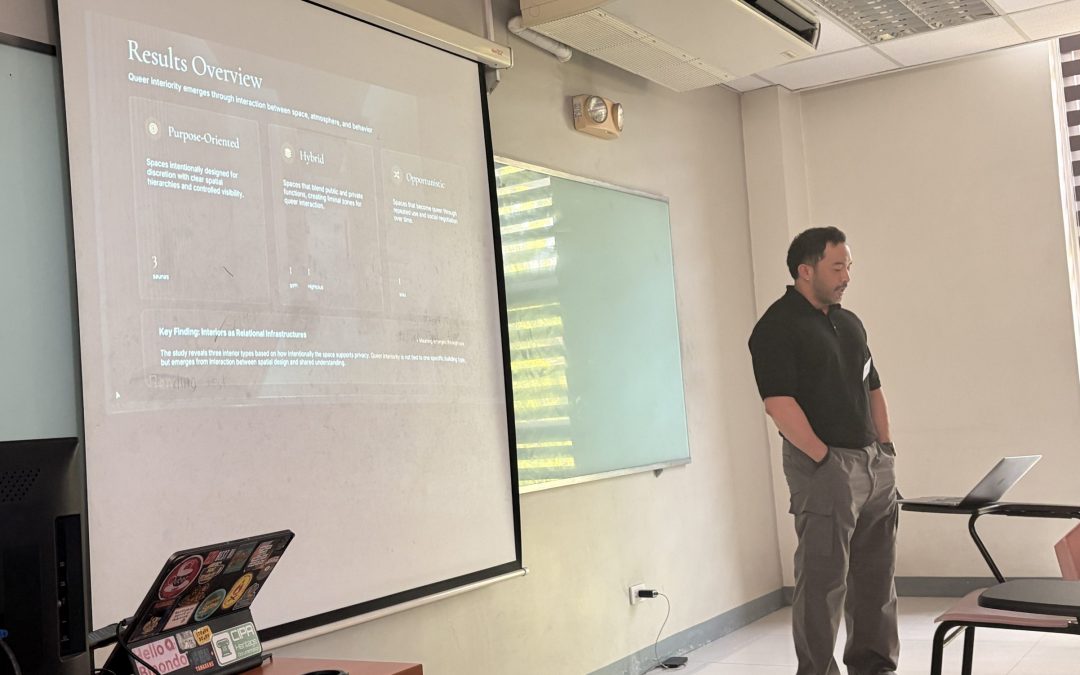
Assistant Professor Lionel Sanchez of the UP Cebu Design Program contributed to the growing body of queer spatial research at the Philippine Queer Studies Conference (PQSC), where he served as a panel presenter during Parallel Session 2 entitled, “Rampa tayo, Ma’am: Designing utopian spatialities”. Bringing a design-centered perspective into the interdisciplinary forum, Sanchez’s presentation foregrounded how everyday environments can quietly shape experiences of safety, belonging, and identity for queer communities.
Titled “Designing for the Unseen: Queer Urban Interiors in Cebu,” the study asks a deceptively simple but urgent question: How do people find safety, connection, and belonging in spaces that were never designed for them?
Sanchez examines a range of interior environments across Cebu–such as gyms, leisure spaces, and semi-public facilities, highlighting how these sites, though not explicitly queer, become navigable through subtle and often unspoken design cues.
Rather than focusing on blatant markers of inclusivity, the research draws attention to the nuanced elements of interior design–lighting, spatial circulation, and atmosphere—that enable individuals to interpret their surroundings. These cues inform decisions to engage, withdraw, or connect, revealing a dynamic relationship between users and space. Through this lens, interiors are understood not merely as physical settings, but as relational environments continuously shaped by perception, behavior, and shared social understanding.
Sanchez’s work documents these lived spatial practices, emphasizing how meaning is constructed through everyday use. It underscores the role of design in fostering not just form and function, but also experiences of comfort, discretion, and social interaction—especially in contexts where visibility can be both empowering and precarious.
The presentation also aligns with the UP Cebu Design Program’s broader research agenda on Urbanity, which interrogates how design operates within complex and evolving urban conditions. By centering informal and often overlooked spaces, the study offers valuable insight into how marginalized communities actively produce meaning within the urban fabric, transforming ordinary interiors into sites of connection and care.
🔗 Learn more about PQSC 2026:
https://www.balangaw.ph/2026-pqsc