
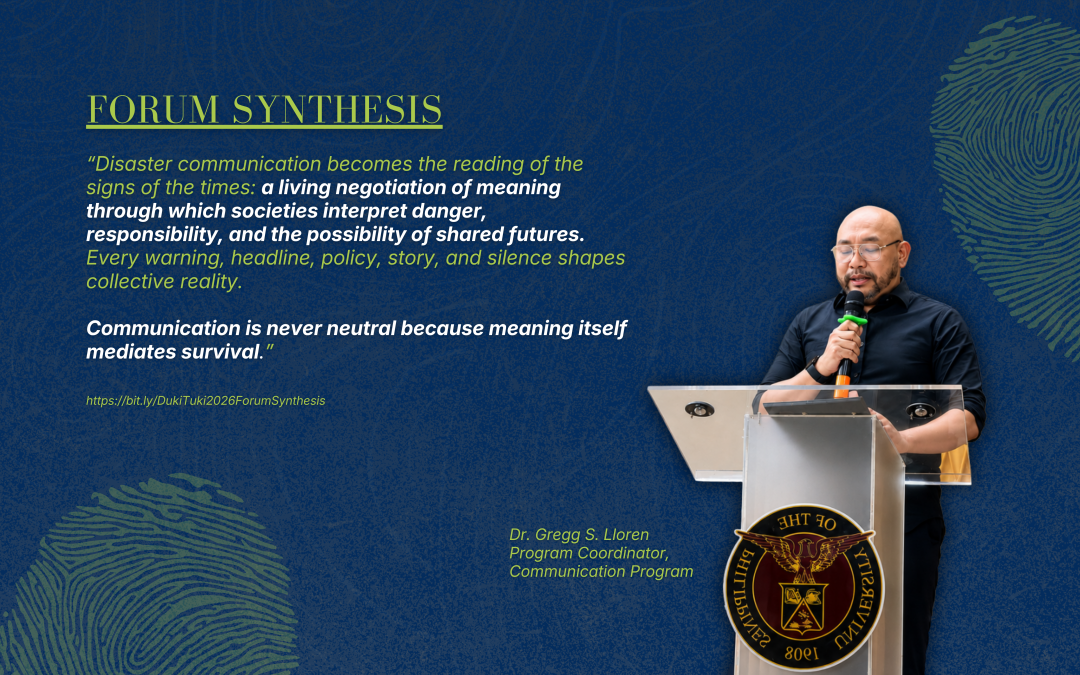
As DukiTuki 2026 concluded, Dr. Gregg S. Lloren, Program Coordinator of the Communication Program, synthesized the forum’s conversations on disaster, communication, and resilience through a critical reflection on the “Reality Machine” and the role of communication in shaping how societies understand and survive crisis.
Read the full synthesis below:
As we bring DukiTuki 2026 to a close, I would like to begin not with an ending, but with a proposition.
Perhaps disaster is not merely the collapse of infrastructure. Perhaps disaster is also the collapse of orientation.
A disruption in how we understand the world. A disruption in how we locate ourselves within it. A disruption in how communities maintain coherence amid uncertainty, fear, and loss.
And if this is true, then communication is not simply the transmission of information during crisis.
Communication becomes the process through which reality itself is reorganized.
This is where I would like to frame today’s synthesis through what I call the ethics of the Reality Machine.
The Reality Machine is not a literal machine. It is the total communicative ecology through which human beings construct meaning together. It includes our media systems, our technologies, our institutions, our stories, our fears, our memories, our bodies, and our relationships with one another.
Reality is never simply given to us. Reality is mediated. Interpreted. Negotiated. Narrated.
And this mediation carries ethical consequences.
The ethical proposition of the Reality Machine is simple, yet demanding: Connection to self, through connection with others, towards a connection to the sublime.
Today’s plenary sessions revealed different dimensions of this process.
Dr. Jonnifer Sinogaya grounded us in the scientific realities of environmental vulnerability—climate systems, hazard projections, rainfall variability, urban heat stress, and rising ecological uncertainty in Cebu. But beyond the scientific data, what emerged was a deeper realization: data alone does not protect communities.
A graph cannot evacuate a family. A forecast cannot produce trust.
Information without communicative integration remains inert. Science becomes socially meaningful only when communities can interpret, internalize, and act upon it together. And so communication becomes the bridge between knowledge and survival.
Retired Colonel Dennis Pastor reminded us that disasters are not caused solely by hazards, but by unmanaged risks and vulnerabilities. This distinction is crucial because it transforms disaster from a purely natural phenomenon into a systemic and communicative one.
A typhoon is natural. But catastrophe often emerges from fractured coordination, weak governance, misinformation, distrust, and unequal access to resources.
Disaster therefore exposes not only environmental instability, but the vulnerabilities of our communicative systems themselves.
Mayor Alfredo Arquillano Jr.’s discussion of the Purok System in San Francisco, Camotes demonstrated how resilience is built not abstractly, but relationally. The strength of the system lies not simply in procedure, but in proximity. Communities respond effectively because communication is immediate, localized, embodied, and trusted.
Before sophisticated technologies, there must first exist social coherence.
This is important because contemporary society often imagines resilience technologically before imagining it communally.
But today’s discussions remind us that communication is infrastructure.
Trust is infrastructure.
Relationships are infrastructure.
Annie Fe Perez-Gallardo’s reflections on community journalism during disaster further deepened this ethical tension. Journalism during crisis is never merely observational. It actively shapes public consciousness under conditions of uncertainty.
Who gets seen? Whose suffering becomes visible? What narratives dominate public attention? How do we report urgently without intensifying panic? How do we remain emotionally truthful without exploiting grief?
These are ethical questions because journalism participates directly in constructing social reality.
In moments of disaster, reporters do not simply document events. They mediate collective perception itself.
Sarah Queblatin’s presentation offered perhaps one of the most profound shifts in perspective today. She moved us from resilience toward regeneration—from survival toward re-storying.
And I think this distinction matters deeply.
Resilience sometimes implies returning to what was. But what if the systems we return to were already broken?
What Sarah reminds us is that communities do not heal through logistics alone. They heal through memory, imagination, cultural continuity, belonging, and the recovery of meaning.
To restore communities is also to restore narrative.
And finally, Dr. Johnrev Guilaran illuminated the psychological dimensions of disaster communication. Disasters are experienced not only physically, but cognitively and emotionally.
Fear alters perception. Uncertainty reshapes behaviour. Communication affects efficacy, hope, panic, cooperation, and collective action.
Human beings do not respond to hazards alone.
We respond to our interpretation of hazards.
In this sense, disaster communication becomes the reading of the signs of the times—not signs as static objects, but as living negotiations of meaning through which societies interpret danger, responsibility, and the possibility of shared futures. Meaning mediates survival.
And this returns us to the ethics of the Reality Machine.
Every warning issued. Every headline written. Every policy framed. Every story amplified. Every silence maintained. All of these contribute to the shaping of reality itself.
Communication is never neutral because meaning is never neutral.
Communication can produce solidarity. Or fragmentation.
It can cultivate preparedness. Or apathy.
It can humanize suffering. Or commodify it.
It can help communities imagine futures worth building. Or trap them within endless cycles of fear.
And perhaps this is why today’s gathering matters. Because DukiTuki is not merely a forum about communication. It is a reminder that communication is one of the primary conditions through which societies survive themselves.
Today’s speakers came from physics, governance, disaster management, journalism, psychology, and community development. Yet despite these disciplinary differences, a shared insight emerged:
No system survives without meaningful coordination between human beings.
And meaningful coordination is ultimately communicative.
The university therefore carries a profound responsibility—not merely to produce knowledge, but to produce ways of relating responsibly to one another under increasingly unstable conditions.
In an age marked by climate anxiety, informational overload, ecological fragility, algorithmic acceleration, and social fragmentation, communication ethics becomes inseparable from survival ethics.
The ethics of the Reality Machine asks us: What realities are we helping construct through our words, systems, technologies, and institutions?
Are we producing isolation or relation? Fear or understanding? Extraction or care? Noise or meaning?
Because the opposite of disaster is not merely safety.
The opposite of disaster is relation.
Connection to self, through connection with others, towards a connection to the sublime.
Not the sublime as abstraction, but as the recognition that human beings survive not individually, but collectively—that meaning, care, and hope emerge relationally.
And perhaps that is the deepest lesson of today:
Resilience is not merely the ability to endure catastrophe.
It is the ability to remain meaningfully human within it.
On behalf of the Communication Program and the organizers of DukiTuki 2026, I extend my deepest gratitude to all our plenary speakers, faculty, students, guests, organizers, and participants for contributing to this vital conversation.
May we continue to communicate not merely to inform, but to connect. Not merely to react, but to understand. Not merely to survive, but to imagine better realities together. And hope for the best of possible world.