
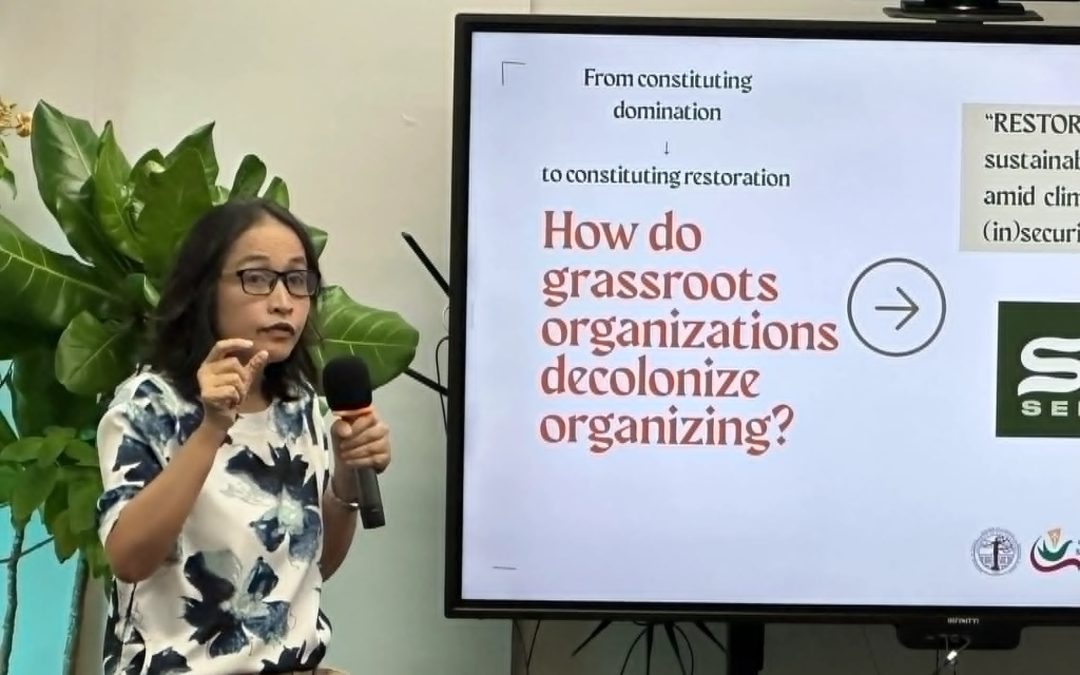
Dr. Crina E. Tañongon, Dean of the College of Communication, Art, and Design (CCAD), University of the Philippines Cebu, Dr. Crina E. Tañongon, Dean of the College of Communication, Art, and Design (CCAD), University of the Philippines Cebu, presented Restore–Restory: A Postcolonial CCO Perspective on Grassroots Alternative Food Systems in Cebu at the international colloquium Foundations, Ferment, and New Frontiers of CCO: Widening the Conversation, held on 15-17 July 2026 at the University of the Philippines Open University (UPOU). Co-authored with Taylor Mitchell of Columbia University, the paper was presented before an international audience of scholars advancing the Communication Constitutes Organization (CCO) framework in the field of Organizational Communication.
The presentation builds on Dr. Tañongon’s earlier Management Communication Quarterly article, “Agribusiness Organizing in the Philippine South: The Intertextual Power Play of Weather and Market Agencies,” which explored how organizing in Philippine agribusiness emerges through the interplay of human, weather, and market agencies, revealing how dominant market discourses can eclipse Indigenous and local ways of organizing.
Drawing from the ongoing Sugbo Seed Archive project, the study introduces Restore–Restory as a communicative mode of decolonial organizing and advances a postcolonial perspective to CCO scholarship. The paper argues that organizing is fundamentally a communicative process of restoration. Through the concept of Restore–Restory, it reconceptualizes organizing not simply as the coordination of people toward predetermined goals, but a process of restoring relationships among people, place, language, ecological memory, and more-than-human actors.
Drawing on the ongoing Sugbo Seed Archive, the study examines the communicative practices of Cebu’s grassroots alternative food movements, showing how storytelling, seed exchanges, cooking demonstrations, vernacular ecological knowledge, and reciprocal relationships with more-than-human actors constitute decolonial organizing and advance food sovereignty. Fieldwork was conducted with Cebu Seed Savers, Communities for Alternative Food Ecosystems, Inc. (CAFEi), the Slow Food Community of Sugbo, and the Visayan Native Tree Enthusiasts (VNTE).
The study forms part of the Sugbo Seed Archive, a collaborative initiative between the Central Visayas Studies Center (CVSC), University of the Philippines Cebu, and the Center for Science and Society, Columbia University, with research assistance from Danna Briones and Fidel Laurence Ricafranca, and fieldwork support from Jay Nathan Jore and Rodrian Apollo Tanongon.
The colloquium featured keynote lectures by Dr. François Cooren of the Université de Montréal, one of the foremost scholars in CCO, and gathered researchers from universities in the Philippines and abroad to explore emerging directions in organization and communication studies. By theorizing Restore–Restory, Dr. Tañongon’s presentation contributes a distinctly Global South perspective to international CCO scholarship, demonstrating how grassroots communities in Cebu organize through communication that restores ecological relationships, cultural memory, and food sovereignty.
Edited on 21/07/2026 – 4:14 PM