
Photos Contributed by InOtherWords Inc. (IOWs)
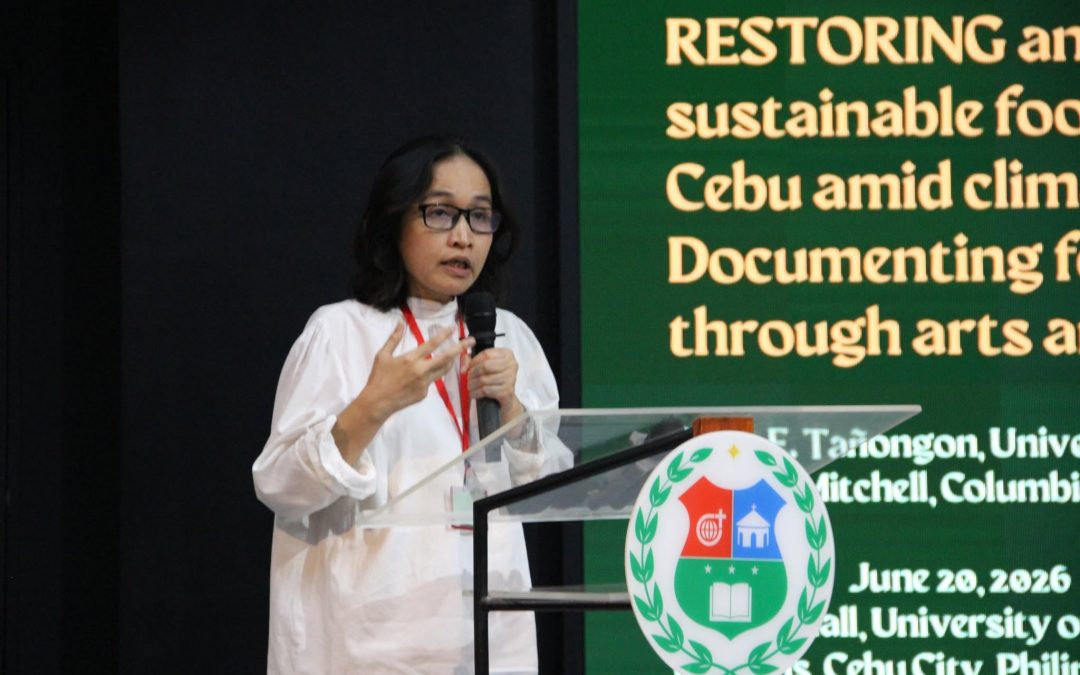
At the Echoes of the Earth Conference held on June 20, CCAD Dean Dr. Crina E. Tañongon, together with Taylor Mitchell of Columbia University presented the Sugbo Seed Archive, a collaborative initiative between the University of the Philippines Cebu through the Central Visayas Studies Center (CVSC) and Columbia University’s Center for Science and Society that documents Cebu’s agrarian cultures, seed-saving traditions, and community-led responses to food insecurity and the climate crisis through a living digital archive. Presented during the conference’s Gikan sa Kabilin ngadto sa Kaugmaon (From Heritage to Future Pathways) session, the project resonated with the gathering’s theme, “Cultural Education for the Environment in the Visayas,” by demonstrating how memory, storytelling, and community participation can cultivate environmental consciousness and strengthen climate resilience.
Held at Rigney Hall at the University of San Carlos (USC), Talamban Campus, Cebu City, the three-day conference was organized by USC’s Cebuano Studies Center in collaboration with In Other Words Incorporated (IOWs) and the National Commission for Culture and the Arts (NCCA). Bringing together scholars, educators, artists, translators, and community practitioners, Echoes of the Earth explored how culture and local knowledge can deepen environmental education and inspire more sustainable futures for the Visayas. Its thematic tracks, ranging from local ecologies and collective care to environmental narratives, language, pedagogy, and heritage, provided a rich interdisciplinary space for conversations on climate resilience grounded in place, culture, and community.
The presentation offered participants a first look at the archive’s evolving vision as a bilingual digital platform developed in collaboration with grassroots organizations such as Global Seed Savers Philippines (GSSP), Communities for Alternative Food Ecosystems (CAFEi), Slow Food Community of Sugbo, and the Visayan Native Tree Enthusiasts (VNTE) committed to ecological regeneration. More than a repository of heirloom seeds and food heritage, it is envisioned as a living community platform that documents and shares stories, memories, local ecological knowledge, and cultural practices that strengthen food sovereignty and climate resilience.
At the heart of the project is the complementary framework of Restorying and Restoring, concepts inspired by the Living Story Landscapes developed by regenerative design specialist Sarah Queblatin. Restore–Restory highlights the power of memory, place-based storytelling, and ecological regeneration in healing landscapes and communities. Building on this foundation, the research adapts the framework to food systems by positioning Restorying as the documentation of food memories, local ecological knowledge, and community narratives through participatory storytelling, while Restoring extends this work by engaging communities in envisioning possible, probable, and preferable futures for sustainable food systems. Rather than preserving memory as an archive of the past, the framework understands collective remembering as a living social process, continually reconstructed through communication, ritual, and shared experience, and as a generative force for ecological renewal.
With the project’s conceptual framework, methodology, and digital platform now publicly introduced, the Sugbo Seed Archive enters its next phase of implementation. Beginning in July, the research team will conduct fieldwork across Cebu, working with Cebu Seed Savers in Bogo, Tabogon, and Tuburan; Slow Food farmers in Catmon; the native tree advocates in Balamban and Sibonga; and urban gardeners and organic farming communities in Cebu City. The stories, practices, and ecological knowledge gathered through these engagements will form the archive’s inaugural collection as the team prepares for the public launch of the bilingual Sugbo Seed Archive in September.