
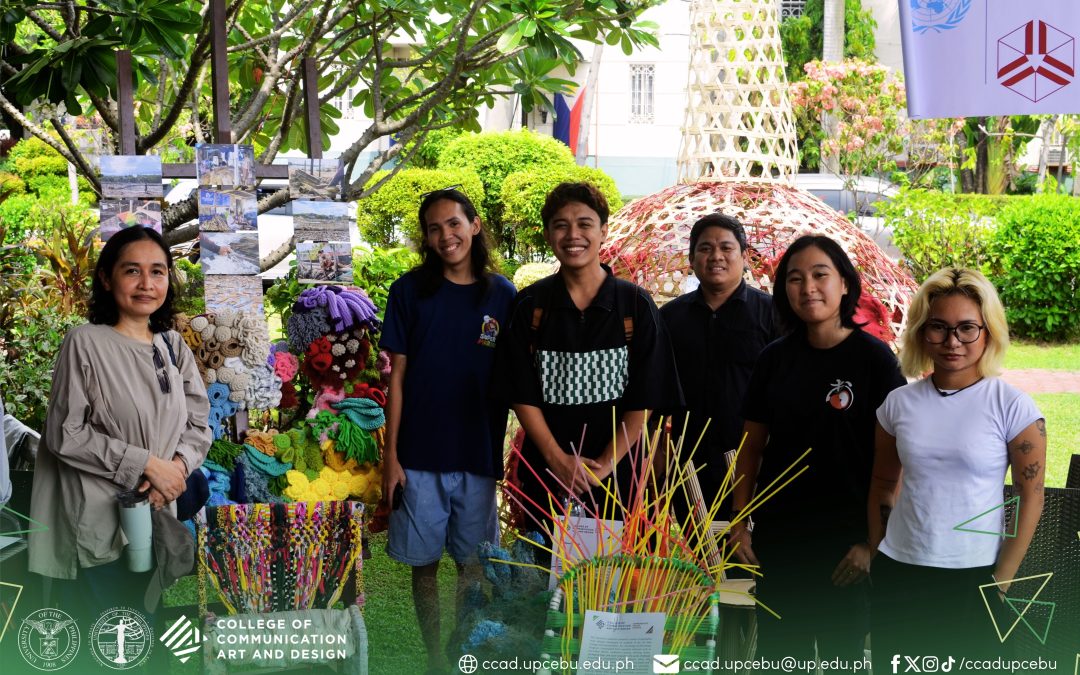
The University of the Philippines Cebu College of Communication, Art, and Design (CCAD) joined environmental advocates, government leaders, civil society organizations, and community stakeholders in commemorating World Environment Day 2026 through the event “Panaghiusa Alang sa Katawhan ug Kinaiyahan: Lihok Na, Karon Na” held on June 5, 2026, at the Cebu Heritage Park within the Cebu Provincial Capitol grounds.
As one of the event’s partner institutions, CCAD reaffirmed its commitment to environmental sustainability by presenting student works that demonstrate how communication, design, and the arts can contribute to conversations on ecological responsibility, community engagement, and climate action.
This year’s observance came at a critical juncture in global environmental discourse. Around the world, efforts to address climate change have increasingly shifted from identifying environmental problems toward implementing concrete and collaborative solutions. From maintaining global warming below the 1.5°C threshold to developing resilient cities and promoting sustainable livelihoods, institutions and communities are being called upon to take a more active role in shaping environmentally responsible futures.
For CCAD, this call to action was reflected in the creative and scholarly works exhibited by its students. Through visual arts, design, and communication projects, the college highlighted how creative practice can serve as a platform for environmental awareness, sustainable innovation, and community-centered advocacy.
Creative Practice as Environmental Action
At the heart of the CCAD exhibit were student works that explored humanity’s relationship with the environment through material experimentation, storytelling, and artistic reflection.
The exhibition showcased projects centered on upcycling and waste reduction, the sustainable use of local and indigenous materials, and the urgent need to protect coastal and marine ecosystems that sustain communities across Cebu and the Visayas.
Rather than treating environmental issues as abstract concepts, the featured works invited audiences to engage with tangible narratives of care, labor, memory, and stewardship.
Weaving Memory and Agriculture: Tamatis by Jovan Gabud
One of the featured works was Tamatis, a woven sculptural piece by Fine Arts – Studio Arts student Jovan Gabud.
Inspired by the tamatis or tomato once cultivated in the agricultural landscapes of Adlaon, Cebu, the work draws from the artist’s personal memories of farming and from the material culture that surrounds rural life. The piece references cultivated crops and woven agricultural objects such as the bakat or bamboo basket, emphasizing the deep connections between land, labor, and community.
Displayed as part of the installation Diskarga, Tamatis explores the repetitive gestures embedded in both farming and weaving. The interlacing of materials mirrors the labor involved in planting, cultivating, harvesting, and transporting crops. Through these accumulated acts of making, the artwork foregrounds care not merely as an idea but as a visible and embodied process.
By connecting traditional agricultural practices with contemporary artistic expression, Gabud’s work reminds viewers of the often-unseen labor that sustains food systems and rural communities.
Stitching the Sea Into Memory: Kung Asa Ko Makita by Candy Regine Casinillo
Environmental concerns surrounding marine ecosystems were powerfully represented through Kung Asa Ko Makita (Where I Am Found) by Fine Arts – Studio Arts student Candy Regine Casinillo.
The crocheted coral artwork draws inspiration from the seas that shape both the artist’s community and identity. Through intricate loops and carefully constructed forms, the work recreates coral structures using fiber, a material that simultaneously conveys delicacy and resilience.
Each stitch echoes the rhythms of the ocean while symbolizing the labor of care required to protect marine environments. In transforming yarn into coral formations, Casinillo invites viewers to reflect on the vulnerability of marine ecosystems and the collective responsibility required to preserve them.
The artwork highlights an important environmental message: that every individual action, no matter how small, contributes to the larger fabric of ecological survival. Like the countless stitches that comprise the work, sustainable futures are built through cumulative acts of care and stewardship.
Exploring Marine Transformation: Balod by April Maureen Burcila
Another notable contribution to the exhibit was Balod, a sculptural work by April Maureen Burcila.
Rooted in an exploration of marine morphogenesis—the continuous shaping and reshaping of forms beneath the sea—the sculpture investigates processes of growth, transformation, and decay within marine environments.
Constructed from paper pulp and cement, Balod combines materials often perceived as opposites. Paper represents fragility and impermanence, while cement evokes durability and permanence. Their union creates a compelling metaphor for marine ecosystems themselves, which are simultaneously resilient and vulnerable.
Its textured surfaces, cavities, and organic protrusions evoke underwater formations caught in an ongoing process of evolution. The sculpture encourages viewers to consider the dynamic nature of ecological systems and the delicate balance that allows them to flourish.
Through material experimentation and environmental reflection, Burcila’s work demonstrates how sculpture can become a means of visualizing ecological processes that are often hidden beneath the ocean’s surface.
Reimagining Waste Through Design
A major highlight of the CCAD exhibit was a collection of speculative furniture designs developed by students from the CCAD Design Program.
Created by Mhelbert Brazil, Rickee Martin Sucayre, Chelsea Castrodes, Alexandra Lambojo, Thom Ilustrisimo, and Samantha Enopia, the collection challenged conventional notions of furniture production, material value, and waste.
The chairs were constructed using upcycled materials such as discarded fabrics, cardboard cartons, drinking straws, used tarpaulins, and packaging tape. Through experimentation with structure, form, and material behavior, the designers transformed everyday refuse into objects of creative inquiry and environmental reflection.
Rather than offering immediate commercial solutions, the furniture pieces functioned as speculative design projects that question patterns of consumption and waste generation. The collection encourages viewers to rethink the life cycle of materials and recognize the hidden potential embedded in discarded objects.
By presenting waste as a resource rather than an endpoint, the works demonstrate how design can contribute to circular economies and promote more sustainable modes of production and consumption.
The project exemplifies how emerging designers can engage critically with environmental challenges while expanding possibilities for creative practice.
Telling Environmental Stories Through Communication
CCAD’s participation also highlighted the role of communication and storytelling in advancing environmental awareness and social engagement.
Among the featured works was the photo story “The Women Behind Every Sweep” produced by Communication students Macy Bueno, Tania Calzita, Andrie Gabutan, Van Guevara, and Athena Romulo for Journ 135B under the guidance of Asst. Prof. Annie Perez-Gallardo.
The project documents the experiences of members of the Labogon Soakers and Broom Makers Association, many of whom are women balancing domestic responsibilities with livelihood work.
Through photographs and narrative storytelling, the students shed light on the invisible labor that sustains families and communities. The photo story emphasizes how broom-making becomes an extension of care work and motherhood, with women collectively working to secure better futures for their children.
By foregrounding local stories of labor, resilience, and sustainability, the project demonstrates how communication can amplify community voices and connect environmental concerns to lived realities.
The work further illustrates how environmental conversations extend beyond ecosystems alone and are deeply intertwined with questions of livelihood, gender, and social justice.
Multi-Sectoral Dialogue for Environmental Action
Beyond the exhibits, the World Environment Day celebration served as a platform for dialogue among government agencies, civil society organizations, environmental advocates, and community groups.
Various civil society organizations presented grassroots programs and policy recommendations directly to the provincial government. The proposals focused on sustainable agriculture and ecological management, including livelihood support for farmers, expanded market access, capacity-building initiatives, post-harvest processing facilities, and investments in solid waste segregation systems.
Leading the celebration was Cebu Governor Pam Baricuatro, who joined Capitol officials in marking the global observance and engaging with stakeholders on pressing environmental concerns.
Governor Baricuatro accepted the recommendations presented by participating organizations and assured attendees that the proposals would be treated as priorities for action. Emphasizing the importance of participatory governance, she underscored the value of listening to communities in shaping public policy, stating that effective governance begins with understanding the needs and perspectives of the people.
In her keynote address, the governor also issued a call for collective responsibility in protecting Cebu’s natural resources and ecosystems, urging every Cebuano to actively participate in environmental stewardship.
Building a Sustainable Future Through Creativity
CCAD’s participation in World Environment Day 2026 highlighted the vital role that creative disciplines play in addressing contemporary environmental challenges.
Across the exhibit, students demonstrated that sustainability is not only a scientific or policy concern but also a cultural and creative one. Through weaving, sculpture, design, and storytelling, they presented alternative ways of understanding environmental issues and imagining sustainable futures.
The featured works revealed how art and design can transform discarded materials into new possibilities, how storytelling can amplify community experiences, and how creative practice can foster deeper engagement with environmental concerns.
As communities worldwide continue to confront the realities of climate change, initiatives such as World Environment Day underscore the importance of collaboration across sectors. The celebration provided an opportunity to showcase how education, communication, and the arts can contribute meaningfully to environmental awareness, community empowerment, and collective action.
CCAD continues to demonstrate that the path toward sustainability is not only shaped by policy and technology, but also by imagination, culture, and the power of human expression.